





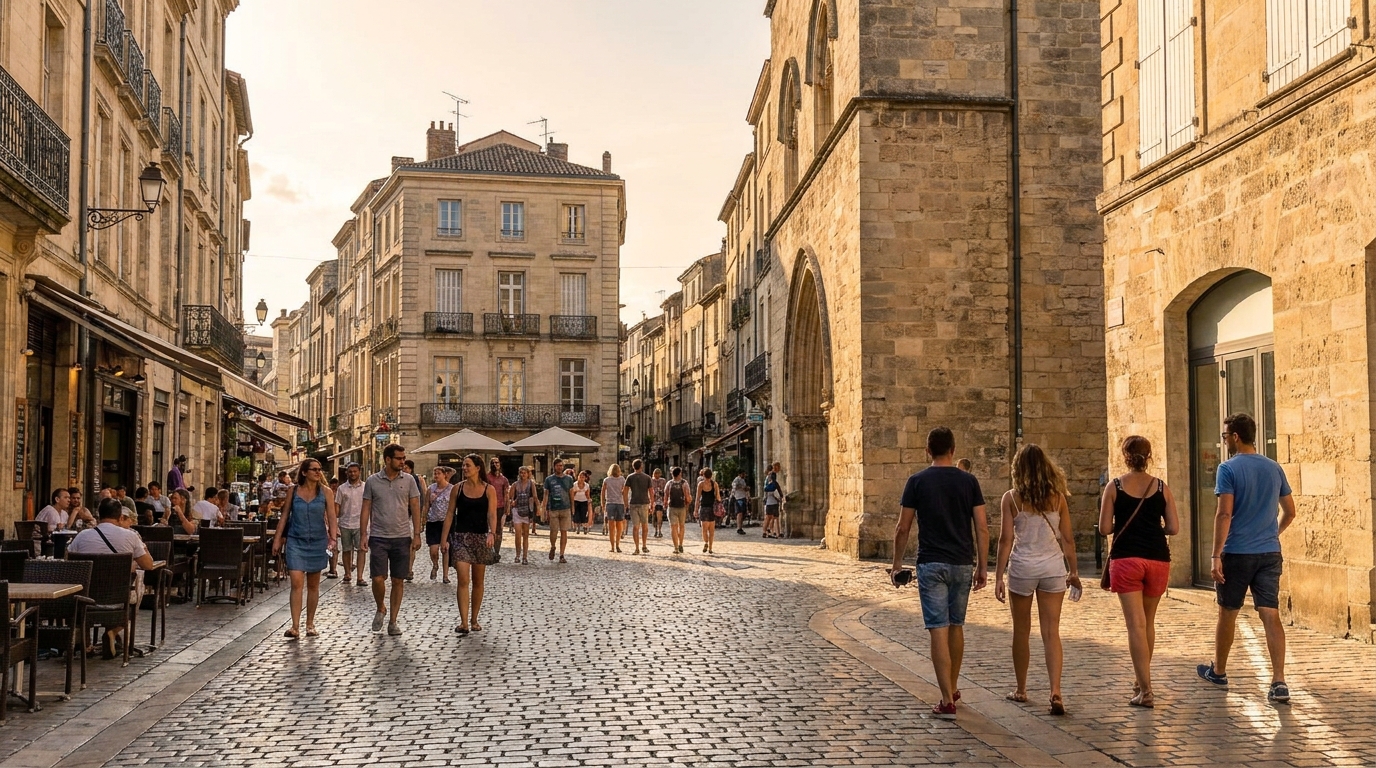

Picture a spring evening on Place de la Comédie: students spilling out of cafés, families sharing an ice cream near the fountain, retirees walking small dogs under the plane trees. This is the everyday face of Montpellier, a city of roughly 300,000 residents where more than a quarter of the population is under 25 and where the Mediterranean lifestyle sets the pace. Yet when you are considering buying a second home or rental investment or moving your family here, one very practical question keeps coming back: is Montpellier, in Occitanie, safe?
The honest answer deserves nuance. Montpellier is a lively, university-driven, cosmopolitan city, and like any city of its size in France it has its brighter and quieter areas. Below, you will find a clear read on the security picture, how it has evolved, and what daily life actually looks like for solo residents, women, and families settling into their French home.
Is Montpellier Safe? The Real Picture Behind the Headlines
Search engines love dramatic statistics, but the lived reality of a city rarely fits a single number. Montpellier sits somewhere in the middle of the French urban ranking for petty crime, comparable to Toulouse or Nice, and safer than several larger metropolitan areas. Most incidents involve theft, scooter-related snatching, and occasional nighttime disturbances rather than violent crime against residents.
What the numbers actually say
Recorded crime in Montpellier, 2025
Montpellier in four safety numbers
These are the offences actually recorded by the police in the commune of Montpellier in 2025, set against the national average. Two things to keep in mind as you read them: they count crimes that were reported, not the ones nobody reports, and every rate is divided by the resident population, so a city with heavy visitor traffic scores higher on street theft than its residents alone would suggest.
Home burglaries
7.70per 1,000 homes
1,417 recorded in 2025
down 39% since 2016
Theft without violence
23.11per 1,000 residents
7,169 recorded in 2025
down 26% since 2016
Assault outside the home
5.02per 1,000 residents
1,556 recorded in 2025
up 13% since 2016
Vehicle theft
2.69per 1,000 residents
836 recorded in 2025
down 17% since 2016
Source: SSMSI, the statistics service of the French Ministry of the Interior, communal database of recorded crime (2025 data, published June 2026). Population and housing figures: INSEE (310,240 residents, 184,054 dwellings). Burglary is measured per 1,000 dwellings, the three other indicators per 1,000 residents.
Buying here? See our Montpellier real estate page: buyer’s agent and renovation studio, handled in English.
According to figures published by the French Ministry of the Interior, the Hérault département registers roughly 60 to 70 non-violent thefts per 1,000 inhabitants annually across its urban core, in line with other southern cities. Assaults remain markedly less frequent and are concentrated in specific nightlife hours and locations. The vast majority of long-term residents report never having experienced a serious incident.
How safety has evolved recently
The city has invested significantly in public safety infrastructure over the past several years. The municipal police force has been reinforced, the video surveillance network expanded across central neighborhoods and tram lines, and lighting upgraded in previously darker corners of the historic *Écusson* (the old town). The tramway itself, one of the most extensive in France, is patrolled and generally considered reliable at all hours.
Neighborhoods where daily life feels calm
If you are picturing where you might live, most established residential neighborhoods offer a very relaxed atmosphere:
- Les Beaux-Arts: bohemian, walkable, popular with young families and creatives.
- Antigone: architecturally striking, quiet in the evenings, close to the river.
- Boutonnet: leafy, residential, favored by academics.
- Aiguelongue and Hôpitaux-Facultés: green, calm, well-suited to family life.
- Port Marianne: modern, family-friendly, close to parks and the tram.
Like any French city, a few peripheral areas (Mosson, La Paillade, parts of Celleneuve) have a more challenging reputation and are simply not where international buyers tend to look. Your local advisor will steer you naturally toward the streets that fit your life project.
→ On the ground
When we walk clients through a property, we always take them around the block at different times of day. A street can feel very different at 8 a.m. school run versus 11 p.m., and that walk tells you more than any statistic.
Everyday Safety for Solo Residents
Whether you are relocating alone, spending long stretches in your French home, or simply visiting to oversee a renovation, Montpellier is a city where solo life feels comfortable and integrated.
Getting around on your own
The four tram lines run from early morning until around midnight, and the network is well used, well lit, and easy to navigate. Central neighborhoods are walkable, and cycling has expanded with dedicated lanes toward the sea and along the Lez river. Taxis and ride-hailing apps operate reliably, which matters when you come back from a late dinner or an evening at the Opéra Comédie.
Building a social life quickly
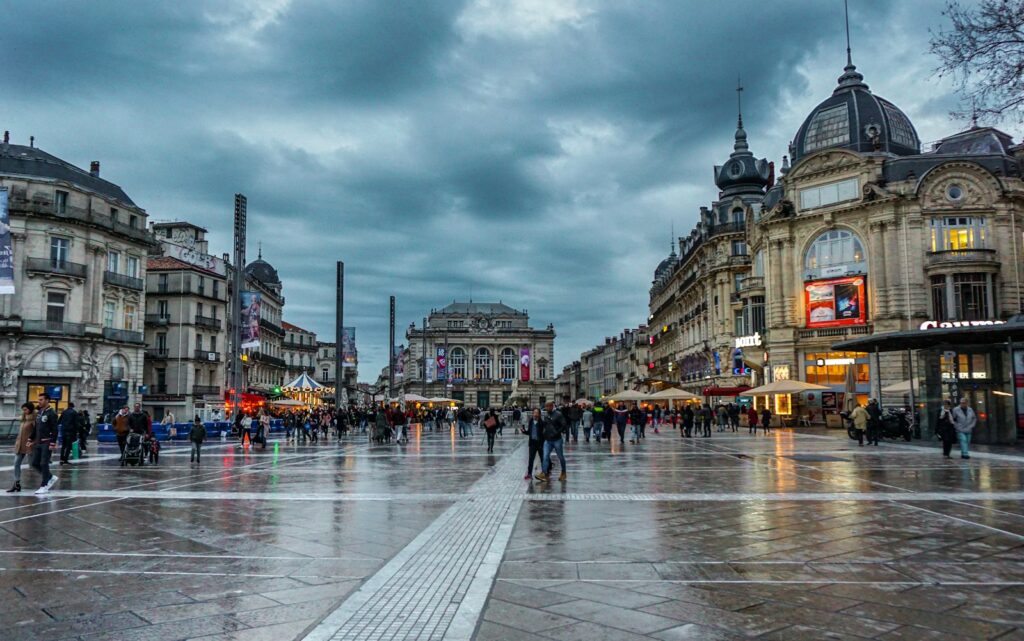
Because the city has around 70,000 students and a large international academic community, meeting people as a solo resident is unusually easy. Language exchanges, cultural associations, weekly markets, and the sprawling café culture around Place Saint-Roch or Place de la Canourgue create natural entry points. That social fabric is, in itself, a form of safety: you are rarely anonymous for long.
Practical habits worth adopting
The same common-sense rules that apply in any European city apply here. Keep your phone out of sight in crowded terraces, be attentive on the tram during rush hour, and avoid leaving anything visible in a parked car. Scooter-based bag snatching does occasionally happen along busy shopping streets, so a crossbody bag worn on the wall side is a small habit that pays off.
Is Montpellier Safe for Women?
This question comes up regularly with the clients of our buyer’s agent, and it deserves a direct answer rather than a diplomatic one. Montpellier is generally considered a comfortable city for women, whether you are living here full-time, running errands, or walking home after dinner.
Daytime and evening rhythms
During the day, the city hums with a mix of professionals, students, and families, and solo women moving through the center attract no particular attention. Evenings around the Écusson, the Esplanade Charles-de-Gaulle, and the main restaurant streets remain animated well past midnight, especially from spring through autumn. That continuous flow of people is reassuring in itself.
Where common sense still matters
Certain quieter side streets in the old town can feel isolated late at night, and the areas immediately around the main train station (Saint-Roch) draw a more mixed crowd after hours. These are the zones where a short taxi ride is worth the small cost, rather than a fifteen-minute walk alone. Most women living in Montpellier settle into their own routines quickly and describe the city as one where they feel at ease.
Support and resources
France has strengthened its national framework for women’s safety, and Montpellier has active local associations, a dedicated municipal helpline, and clearly marked *points d’accueil* (support points) in public buildings. Your notaire or property advisor can point you to the practical resources of your specific *arrondissement*.
→ Good to know
If you are buying an apartment in the historic center, ask specifically about the building’s *digicode* entry system, whether there is a *gardien* (building caretaker), and how the courtyard is lit at night. These small architectural details shape how safe your home feels on a Tuesday evening in November.
Family Life: Raising Children in Montpellier
For families relocating from the US, the UK, or elsewhere, safety is inseparable from the broader question of quality of life. Here, the city has quietly become one of France’s most family-oriented urban destinations.
Schools, parks, and pediatric care
Montpellier hosts an extensive network of public schools, several bilingual and international programs, and the well-regarded École Internationale de Montpellier. Green spaces are woven into the fabric of the city: the Jardin des Plantes (the oldest botanical garden in France), Parc Montcalm, the Domaine de Grammont, and the beaches of Palavas and Carnon just twenty minutes away. The CHU de Montpellier is one of the leading university hospitals in southern France, with a strong pediatric department.
The school run and daily rhythm
Families consistently report that daily logistics feel calm here. Children walk or tram to school from age eleven or so, sports clubs are affordable, and the *centres de loisirs* (after-school and holiday programs run by the city) are extensively used. The Mediterranean climate encourages outdoor life almost year-round, which shapes the kind of childhood you can offer.
Choosing the right neighborhood for family life
Not every area of the city works equally well for a family with school-aged children. Here is a simplified comparison of neighborhoods our clients frequently consider:
| Neighborhood | Family profile | Approx. price per m² | Feel |
|---|---|---|---|
| Les Beaux-Arts | Creative, urban families | €4,200 to €5,500 | Lively, walkable |
| Aiguelongue | Families wanting a garden | €4,000 to €5,200 | Green, residential |
| Port Marianne | Modern-living families | €4,500 to €6,000 | New-build, tram-served |
| Boutonnet | Academic, established families | €4,300 to €5,600 | Quiet, tree-lined |
| Écusson (old town) | Second-home buyers, older children | €4,500 to €6,500 | Historic, animated |
These are indicative brackets and shift with market conditions and the specific street. A well-renovated apartment with a terrace or a *maison de ville* with a courtyard will sit at the top of each range.
What families tell us after settling in
The feedback we hear most often from clients who have moved with children touches less on statistics and more on texture: the weekly market at Arceaux where the children know the cheese seller, the ease of a Sunday cycle along the Lez, evenings at a neighborhood pizzeria without needing to book. That texture is what turns an address into a home.
→ The key point
The safest neighborhood for a family is the one whose daily rhythm matches yours. Match the school, the tram line, and the pace of the street to your real weekly life, and the abstract question of safety largely takes care of itself.
Buying Your French Home in Montpellier With Peace of Mind
Safety in a city is one thing; safety in a property transaction is another. Both matter when you are building a life here from abroad.
The steps of a French purchase
Buying property in France follows a well-defined path, and knowing it in advance removes most of the anxiety. In short:
- Offer and negotiation: usually handled through the agent or directly with a private seller.
- Compromis de vente: the preliminary sales agreement, signed once terms are settled. It commits both parties, subject to conditions such as financing.
- Ten-day cooling-off period: a legal right for the buyer to withdraw without penalty.
- Notaire due diligence: the *notaire* (a public officer, not just a lawyer) verifies title, urbanism rules, easements, and building compliance.
- Acte authentique: the final deed, signed at the notaire’s office. Keys are handed over the same day.
Between signatures, a well-organized purchase typically takes three to four months.
Why a local team changes the experience
Reading the market from abroad, in a second language, is genuinely difficult. Two apartments on the same street can differ by 30% in real value once you factor in the *copropriété* charges, the state of the roof, the *DPE* (the energy performance diagnostic, mandatory in France), and the microphysics of the neighborhood at 6 p.m. on a school day. A trusted network of local agents, notaires, and tradespeople on the ground is what turns a promising listing into a sound decision.
A turnkey approach to your life project
Our clients are usually building something more than a portfolio: a second home for the summer, a base for retirement, a family relocation. That is why we handle the search, the negotiation, the notaire coordination, the renovation, and the design as a single project, in English, with real people you can call. The goal is straightforward clarity from the first video call to the day you unlock the door.
A Final Word on Living Safely in Montpellier
So, is Montpellier safe? For the vast majority of residents, and certainly for the international buyers we accompany, the answer is yes: it is a mid-sized Mediterranean city where daily life unfolds calmly, where the tram runs on time, and where a solo evening walk home from a friend’s apartment is usually uneventful. Pockets of concern exist, as they do everywhere, and knowing the map matters.
What ultimately shapes your experience is not a citywide statistic but the specific street, building, and rhythm you choose. That is a decision best made with someone who knows the ground, who has walked those streets in every season, and who can read what a listing does not say.
If Montpellier is on your shortlist for a second home or a full move, we would be glad to talk through your project, your neighborhood options, and what a turnkey purchase could look like for you. Your French home deserves that kind of considered start.