





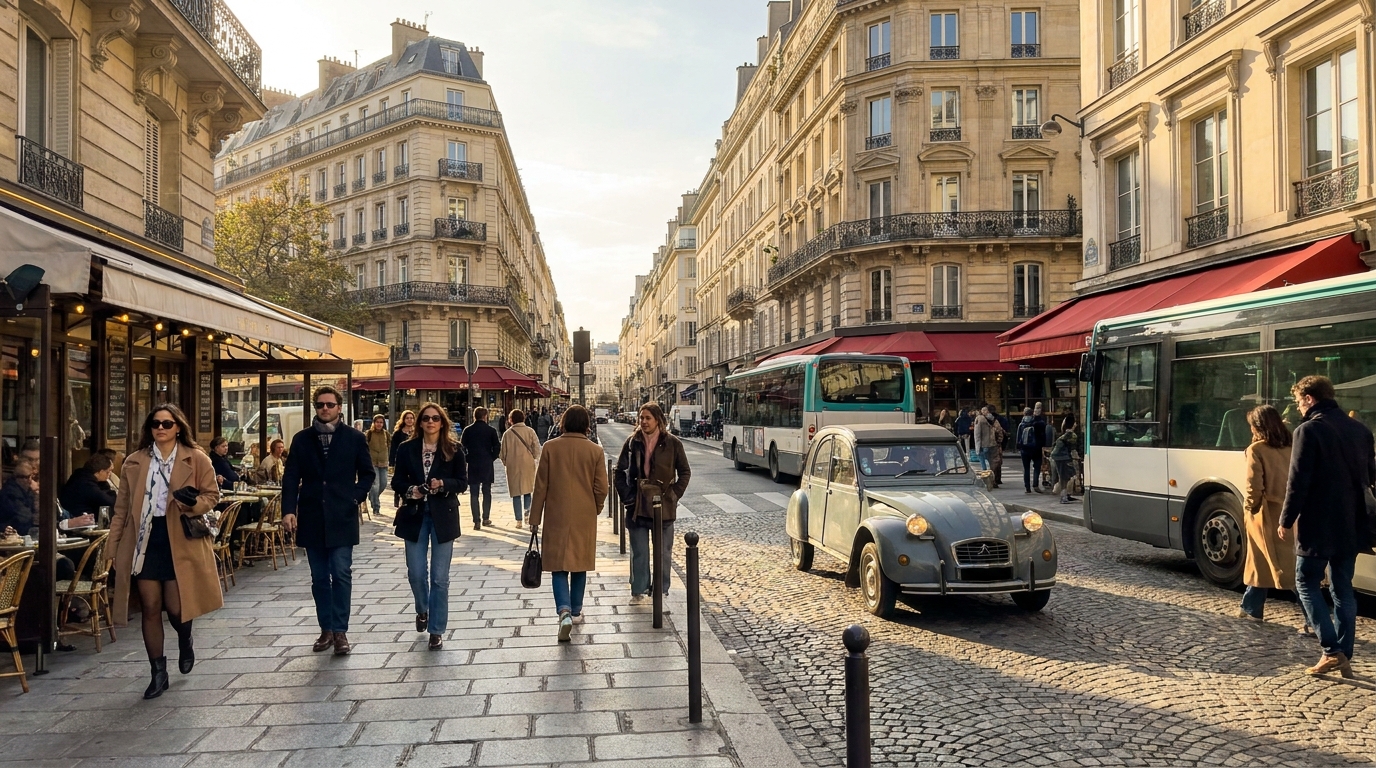

Picture this: you close your laptop after another long day, and the daydream returns. A wrought-iron balcony above a quiet street in the 6th, morning light on the zinc rooftops, a corner boulangerie two doors down. Then a question surfaces, the one every serious buyer eventually asks their partner over dinner. Is Paris safe, really, for someone moving here for a season, a school year, or the rest of a life project?
It deserves a real answer, not a headline. Paris is one of the most visited cities on earth, home to roughly 2.1 million residents in the city proper and around 12 million in the wider Île-de-France region. Like any major capital, it rewards awareness and rewards those who know its rhythms. Below, a calm, on-the-ground picture of what safety actually looks like for the people who choose to call this city home.
Is Paris Safe? The Honest Picture
The short answer: yes, Paris is broadly safe, particularly by the standards of large global capitals. The longer answer is more useful, because safety in a city of this size is never uniform across neighborhoods, hours, or lifestyles.
What the numbers actually say
Violent crime in Paris remains low compared to most American metropolitan areas of comparable size. The homicide rate in the city hovers around 1 to 2 per 100,000 inhabitants, a fraction of what you see in many US cities. What visitors and new residents do encounter, more often, is petty crime: pickpocketing on the metro, phone snatching near tourist landmarks, and occasional bag-lifting in busy cafés.
Recorded crime in Paris, 2025
Paris in four safety numbers
These are the offences actually recorded by the police in the commune of Paris in 2025, set against the national average. Two things to keep in mind as you read them: they count crimes that were reported, not the ones nobody reports, and every rate is divided by the resident population, so a city with heavy visitor traffic scores higher on street theft than its residents alone would suggest.
Home burglaries
5.05per 1,000 homes
7,072 recorded in 2025
down 25% since 2016
Theft without violence
45.12per 1,000 residents
94,924 recorded in 2025
down 28% since 2016
Assault outside the home
5.27per 1,000 residents
11,095 recorded in 2025
up 14% since 2016
Vehicle theft
1.73per 1,000 residents
3,648 recorded in 2025
down 59% since 2016
Source: SSMSI, the statistics service of the French Ministry of the Interior, communal database of recorded crime (2025 data, published June 2026). Population and housing figures: INSEE (2,103,778 residents, 1,399,122 dwellings). Burglary is measured per 1,000 dwellings, the three other indicators per 1,000 residents.
Serious violent incidents against residents in residential arrondissements are rare. The everyday texture of the city, walking home from dinner, taking the bus, picking up kids from school, feels calm and predictable once you know your quarter.
How safety has evolved
The city has invested significantly in public safety infrastructure over recent years, particularly around the metro network, major transport hubs, and iconic sites. Camera coverage has expanded, police presence in tourist-heavy zones has grown, and residents in most neighborhoods report a steady sense of order in daily life.
There are still areas where petty crime spikes, especially around the Gare du Nord, parts of Châtelet-Les Halles, and the immediate perimeter of the Eiffel Tower and Trocadéro. These are places to stay alert, not places to avoid.
→ On the ground
The safest posture in Paris is not fear, it is attention. Keep your phone off the café table on a busy terrace, use an inside pocket on the metro, and you eliminate the great majority of the risk residents encounter.
Neighborhood by Neighborhood: Where Life Feels Easy
Ask ten Parisians where they feel most at ease and you’ll get ten answers, each shaped by their routine. What matters when you’re choosing a home is not a ranking but a match between your daily life and the character of the arrondissement (Paris’s numbered administrative districts).
The classic residential arrondissements
The 6th, 7th, 8th, and 16th have long been synonymous with quiet residential comfort. Tree-lined avenues, embassies, private schools, neighborhood markets. Families with children often gravitate here for the calm streets and the density of green spaces like the Champ-de-Mars and Parc Monceau.
The 4th and parts of the 3rd, in the Marais, offer a different flavor: dense, lively, safe well into the evening thanks to constant foot traffic. You pay for that vibrancy in square-meter prices, but the trade is a neighborhood that feels alive at almost every hour.
The rising quarters
The 9th, 10th around the Canal Saint-Martin, 11th around Bastille and Père-Lachaise, and pockets of the 18th around Abbesses have transformed into some of the most sought-after addresses for younger buyers and families who want cafés, independent shops, and a genuine sense of local community.
These areas require slightly more homework. A single street can change character in fifty meters. That is precisely where local guidance becomes irreplaceable.
A quick reference on typical price ranges
| Arrondissement | Profile | Average € / m² |
|---|---|---|
| 6th / 7th | Quiet, classic, family-friendly | 14,000 to 17,000 |
| 16th | Residential, green, schools | 11,000 to 14,000 |
| 4th / Marais | Lively, walkable, historic | 13,000 to 16,000 |
| 11th | Trendy, mixed, young families | 10,000 to 12,500 |
| 10th / Canal | Creative, evolving quickly | 9,500 to 11,500 |
Solo Travelers and Newcomers Settling In
Moving to a new city alone brings its own kind of vulnerability, and its own kind of freedom. Paris tends to be generous to those who arrive curious and cautious in equal measure.
Getting around after dark
The metro runs until roughly 1:15 a.m. on weeknights and 2:15 a.m. on weekends. After that, the Noctilien night buses take over, and taxis or ride-hailing apps are plentiful. Walking home in the central arrondissements is generally uneventful, though most residents naturally avoid empty side streets in favor of well-lit avenues.
A useful habit: download the RATP or Citymapper app and get familiar with your two closest metro lines and one bus route home. Redundancy in your commute is quiet insurance.
Building the local rhythm
Solo residents tell us the same thing over and over: the moment Paris starts to feel like home is the moment the boulanger, the neighborhood pharmacist, and the café owner on your corner recognize you. That web of small daily relationships is not just charming, it is protective. People notice when you don’t show up, and they notice strangers on your street.
→ Good to know
When you first move in, introduce yourself to your building’s gardien or syndic (the building caretaker or management representative). They are your first line of practical guidance, from package delivery to who to call when the boiler stops.
For Women Living in Paris
A separate question deserves a separate look, because women’s experience of any city is shaped by realities male residents don’t always see.
Day-to-day experience
Most women who move to Paris describe daily life as comfortable and largely uneventful. Running errands, working from a café, commuting to an office, picking up children from the école maternelle (French preschool) all fall into the rhythm of a functioning European capital.
Street harassment does exist, more often in the form of unwanted comments than genuine threats. It tends to concentrate in certain transport hubs and busy nightlife strips rather than in residential neighborhoods.
Practical habits that work
Longtime female residents rely on a handful of simple habits:
- Choose apartments in buildings with a coded entry (digicode) and, ideally, a gardien on site.
- Favor metro cars near the front, closer to the driver, when traveling late.
- Use licensed taxis (G7) or ride-hailing apps rather than unmarked cars offering rides outside stations.
- Trust the neighborhood test: walk it on a Tuesday evening at 9 p.m., not only on a Saturday afternoon.
None of this is unique to Paris. It is simply urban common sense, and it works.
Raising a Family in Paris
Families are perhaps the most careful buyers we work with, and rightly so. The city offers extraordinary quality of life for children, provided you choose your quarter and your building with clarity.
Schools and daily logistics
The French public school system is strong, free, and universal, and Paris also hosts a dense network of bilingual and international schools: the American School, the British School, the École Jeannine Manuel, and several fully bilingual public and private options. Proximity to your chosen school is one of the strongest anchors when picking a neighborhood.
Playgrounds are everywhere. Parks like the Luxembourg, Monceau, Buttes-Chaumont, and the Bois de Boulogne offer real green space within walking or short-metro distance from most family neighborhoods.
Building safety for children
For families, safety is often less about the city and more about the building. Elevator condition, staircase lighting, courtyard access, the presence of a gardien, the state of the shared entrance. These details matter every single day and are easy to miss on a rushed viewing.
→ The key point
Before you commit, ask for the last two years of procès-verbaux d’assemblée générale, the minutes of the building’s owner meetings. They reveal disputes, planned work, and how the building is actually run, which shapes daily safety more than any street-level statistic.
Practical Steps to Judge Safety Before You Buy
Between browsing listings and signing at the notaire (the French public officer who handles all property transfers), there is a due-diligence stretch where a calm, informed approach makes the difference.
Visit at different hours
Every serious buyer should walk their shortlisted street at three different moments: a weekday morning during the school run, a weekday evening around 8 or 9 p.m., and a Sunday afternoon. You will learn more in those three visits than in any online research.
Notice noise, foot traffic, the mix of shops, the presence of families, the cleanliness of the sidewalk. These signals compound.
Read the building, not just the apartment
A beautiful apartment in a poorly managed building will disappoint. A modest apartment in a well-run building with attentive neighbors will feel like home from week one. When we accompany clients on viewings, we look as carefully at the shared entrance, the mailbox area, the courtyard, and the elevator as we do at the apartment itself.
Use the right local resources
Official sources like the Ministry of the Interior’s neighborhood-level crime statistics are useful, but they miss texture. Local mairie (town hall) offices publish neighborhood councils’ reports; local Facebook groups and neighborhood associations give unfiltered resident perspectives. A local advisor synthesizes all of it against your specific criteria.
Where FRE Comes In
Asking is Paris safe is really asking a bigger question: will my daily life here feel good, protected, and worth the move? That question is answered on the ground, not in a spreadsheet.
A team that lives here
Our advisors walk these streets, work with the local notaires, and know which building on which corner is well run and which one has a leaking roof the seller isn’t mentioning. We handle the search, the negotiation, the paperwork, the renovation coordination, and the furnishing, in English, with a project manager who is genuinely on the ground.
A turnkey approach to your French home
The value of a trusted network shows up in the details: the architect who understands Haussmannian layouts, the artisan who can restore original parquet without destroying it, the local craftsmanship that turns a good apartment into your French home. That is what a real relationship provides, and what no algorithm reads.
Curious about a specific neighborhood, a school catchment, or a building you have already spotted online? Reach out. We will walk it with you, literally or virtually, and give you the clarity to move forward with peace of mind.
Bringing It Together
Paris is a safe city for those who approach it as residents rather than tourists. The overall trend across recent years has been positive investment in public safety, stronger neighborhood cohesion, and a city that continues to reward those who choose it thoughtfully. Solo newcomers, women setting down roots, and families with children all find a daily rhythm here that feels grounded, once the right neighborhood and the right building come together.
The question was never really is Paris safe. It was: will Paris feel like home? With the right guidance, the right street, and the right team beside you, the answer tends to be a quiet, confident yes. Your French art de vivre is closer than you think, and it deserves to be built on real foundations.