





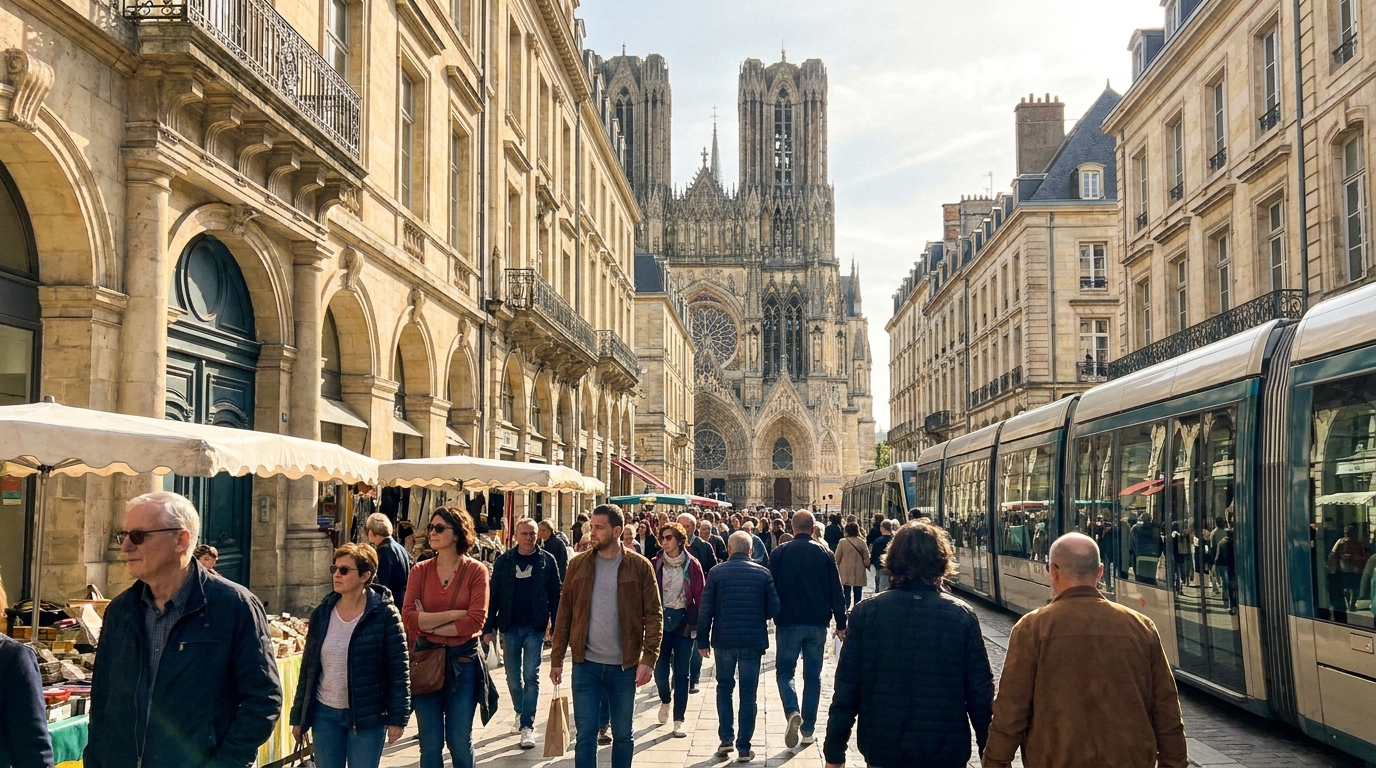

Picture a Saturday morning on Place Drouet d’Erlon: cafés filling up with locals reading the paper, families walking toward the cathedral, students cycling to the covered market. This is the everyday face of Reims, a city of roughly 180,000 residents that anchors the Champagne region and sits just 45 minutes from Paris by TGV. If you are weighing a move here, whether for a second home or rental investment, a family relocation, or a slower pace of life, one question tends to surface early: is Reims, in Grand Est, safe?
The short answer is yes, with the usual nuances that apply to any mid-sized French city. The longer answer, the one that actually helps you plan a life project, deserves a closer look at neighborhoods, recent trends, and the daily experience of solo travelers, women, and families.
Reims at a Glance: The Real Safety Picture
Reims is generally considered one of the calmer regional capitals in northern France. It carries the weight of a UNESCO-listed cathedral, two universities, a well-regarded business school, and a wine economy that keeps the city both prosperous and internationally visible. All of this shapes a public space that feels lived-in rather than tense.
Recorded crime in Reims, 2025
Reims in four safety numbers
These are the offences actually recorded by the police in the commune of Reims in 2025, set against the national average. Two things to keep in mind as you read them: they count crimes that were reported, not the ones nobody reports, and every rate is divided by the resident population, so a city with heavy visitor traffic scores higher on street theft than its residents alone would suggest.
Home burglaries
4.21per 1,000 homes
449 recorded in 2025
down 14% since 2016
Theft without violence
12.88per 1,000 residents
2,288 recorded in 2025
up 15% since 2016
Assault outside the home
5.79per 1,000 residents
1,029 recorded in 2025
up 24% since 2016
Vehicle theft
3.56per 1,000 residents
632 recorded in 2025
broadly stable since 2016
Source: SSMSI, the statistics service of the French Ministry of the Interior, communal database of recorded crime (2025 data, published June 2026). Population and housing figures: INSEE (177,674 residents, 106,715 dwellings). Burglary is measured per 1,000 dwellings, the three other indicators per 1,000 residents.
Buying here? See our Reims real estate page: buyer’s agent and renovation studio, handled in English.
How Reims Compares to Other French Cities
National crime statistics place Reims broadly in line with cities of similar size such as Dijon, Angers, or Tours. Property-related incidents, mostly bike theft and occasional car break-ins, sit slightly above the national average, while violent crime remains low and heavily concentrated in a handful of areas away from the historic center. For a family or an international buyer settling in the central arrondissements, daily life feels closer to a large town than a metropolis.
The Feel of the City on a Normal Day
Walk from the cathedral to the Halles du Boulingrin and you cross a pedestrian core that stays active into the evening. Terraces are busy, the tram runs on time, and police and municipal officers have a visible but discreet presence. That texture matters more than headline numbers when you are trying to imagine your own week here.
→ On the ground
Spend a full weekend in Reims before committing to a neighborhood. Walk the same streets on Saturday afternoon and Tuesday evening; the atmosphere at different hours tells you more than any statistic.
How Safety in Reims Has Evolved Recently
The city has invested consistently in urban renewal, lighting, and public transport, and those choices are visible on the ground. The tram network, expanded neighborhood policing, and the redesign of several squares have all contributed to a safer feel in the center and along the main axes.
Urban Renewal in Sensitive Neighborhoods
Areas historically flagged as more fragile, notably Croix-Rouge and parts of Orgeval, have been the focus of major redevelopment programs, with housing rebuilt, public spaces reopened, and new schools and community facilities. Progress is uneven, and these neighborhoods still concentrate most of the reported incidents, but the trajectory has clearly moved toward integration rather than isolation.
What the Numbers Actually Say
Reims has seen the same broad national patterns as other French cities: a modest rise in petty theft and household burglaries over recent years, balanced by stable or declining rates of physical assault in most districts. The typical concerns for a new resident are pragmatic ones, protecting a bike, securing a ground-floor apartment, being sensible with valuables in a parked car, rather than anything that should reshape your decision to live here.
Concrete Everyday Reflexes
A few habits go a long way: a solid U-lock rather than a cable lock, a reinforced door with an A2P-certified cylinder for your apartment, and standard vigilance on late-night trams. These are the same reflexes you would adopt in Lyon, Nantes, or Bordeaux.
Neighborhoods: Where to Look, Where to Pause
Not every district reads the same, and this is where local guidance genuinely changes outcomes. A quick map search cannot tell you that one side of a street feels lively at 10 p.m. while the other empties out, but a walk with someone who lives here can.
Central and Highly Recommended Areas
- Cathedrale / Centre-Ville: elegant, walkable, a strong choice for a pied-à-terre or a family apartment near schools and culture.
- Clairmarais: close to the train station, popular with professionals commuting to Paris, calm and well connected.
- Boulingrin / Cérès: the market district, animated but residential, favored by young families and retirees alike.
- Chemin Vert (upper part): leafy, more suburban, appreciated by families wanting a garden without leaving the city.
- Saint-Remi: historic and quieter, near the basilica, with beautiful stone façades and a village feel.
Areas That Warrant a Closer Look
Croix-Rouge, parts of Orgeval, and Wilson concentrate most of the socio-economic difficulties of the city. This does not mean they are unsafe for a visit, and some pockets are being genuinely transformed, but they are rarely where an international buyer will look for a home. If a listing there catches your eye because of the price, that is precisely the moment to lean on local advice before signing anything.
→ Good to know
In Reims, a five-minute walk can change the character of a street entirely. Always confirm the exact block, not just the district name, before making an offer.
Is Reims Safe for Solo Travelers?
Reims regularly appears on short lists of French cities that are pleasant to explore alone, thanks to a compact center, excellent transport links, and a steady flow of visitors coming for Champagne tastings and cathedral tours.
Getting Around on Your Own
The tram and bus network runs late enough to cover dinner and a concert, and taxis and ride-hailing apps operate reliably. The train station sits inside the city, which spares you the awkward late-night arrivals that plague more sprawling destinations. Walking back to a central hotel or rental after 11 p.m. is, for most visitors, uneventful.
Evenings, Bars, and the Student Scene
Place Drouet d’Erlon is the heart of the nightlife, lively without being rowdy, and the student population keeps a good rhythm during the academic year. As anywhere, the usual reflexes apply: keep an eye on your drink, know how you are getting home, and avoid the small pockets around the station that thin out very late at night.
Is Reims Safe for Female Travelers and Residents?
Women who visit or live in Reims tend to describe the city as comfortable, walkable, and free of the constant background noise of larger metropolitan areas. That said, honest guidance is more useful than blanket reassurance.
Daily Life and the Public Space
The center is well lit, populated into the evening, and generally respectful. Cafés, markets, and cultural venues are easy to enjoy alone. Cycling infrastructure has improved significantly, and the tram feels safe at most hours, with cameras and a visible staff presence.
Practical Reflexes That Help
If your building has a shared entrance, choose one with a working code and, ideally, a videophone. When renting a car for weekend outings in the vineyards, park in monitored lots overnight rather than on the street. And keep in mind that some quieter residential streets can feel isolated after dark; a slightly longer walk along a busier axis is often the better choice.
Is Reims Safe for Families Considering a Move?
Families are, in many ways, the audience for whom Reims makes the most immediate sense. The city offers the cultural depth of a historic capital, strong schools, a manageable scale, and green space that is genuinely usable.
Schools, Parks, and Daily Rhythm
Reims hosts respected public schools, several private options including bilingual tracks, and higher education institutions that keep the city intellectually alive. Parc de Champagne, the banks of the canal, and the Coulée Verte give children real outdoor space. The pace is unhurried, which is often what families come here looking for in the first place.
Choosing the Right Neighborhood for Kids
Families tend to gravitate toward the upper Chemin Vert, Saint-Remi, and the residential edges of the center, where quiet streets, schools, and playgrounds cluster together. Some also look just outside the city, in villages like Cormontreuil, Tinqueux, or Bezannes, which combine larger homes and gardens with easy access to Reims and the TGV.
A Comparison to Help You Position Yourself
| Profile | Recommended areas | Typical budget (purchase) |
|---|---|---|
| Solo buyer, pied-à-terre | Cathedrale, Clairmarais | €180,000 to €320,000 for a well-placed 2-bed apartment |
| Couple, second home | Boulingrin, Saint-Remi | €250,000 to €450,000 for a character apartment or small townhouse |
| Family relocation | Upper Chemin Vert, Bezannes, Cormontreuil | €400,000 to €750,000 for a family house with garden |
→ The key point
School catchment areas in France are strict, and the right address by a hundred meters can determine which school your children attend. Verify the carte scolaire before you commit.
Buying a Home in Reims With Confidence
Safety is only one part of the picture. Buying in France as an international client involves a legal framework that is protective but unfamiliar, and the real risks tend to sit in the paperwork rather than on the street.
The Steps, Briefly
A French purchase moves through a clear sequence: the compromis de vente (the preliminary contract that binds both parties), a mandatory cooling-off period, the ordering of technical diagnostics including the DPE (the energy performance certificate), and finally the signing of the acte authentique at the office of the notaire, the public officer who validates the sale. Each stage has its own deadlines and conditions.
What Local Guidance Actually Changes
Reading the market from a distance is difficult. Prices vary street by street, condominium regulations can hide surprises, and renovation costs in the Reims area range from €1,200 per square meter for a light refresh to €2,500 or more for a full overhaul with good craftsmanship. Having a team on the ground means you see the right properties, avoid the ones that look better online than in person, and negotiate with the market data that only local practice provides.
A Turnkey Approach for International Buyers
For clients who cannot fly in every month, we handle sourcing, visits by video, negotiation, coordination with the notaire, and, when relevant, renovation and furnishing. The idea is simple: you keep clarity and peace of mind, and the project stays on track between your visits.
So, Is Reims a City Where You Can See Yourself Living?
If safety was your first question, it should not be your last one. Reims is a city that rewards a slower reading: the light on the cathedral at the end of the afternoon, the smell of the bakery on rue de Vesle, a glass of blanc de blancs at a table you now recognize. The safety picture is reassuring, the neighborhoods are readable once you have someone to read them with you, and the everyday rhythm is exactly what most of our clients are hoping to find.
The next step, if this article has answered the first question and raised ten more, is a conversation. Tell us what your life project in France looks like, and we will help you translate it into a shortlist of neighborhoods, a realistic budget, and a plan for your French home, handled by a real team, on the ground, in English, from first visit to first dinner in your new dining room.