






One basis point. That is sometimes all that stands between a French home project that pencils out and one that quietly slips out of reach. After years of rate volatility across the eurozone, financing conditions have become the single most decisive lever for anyone buying property in France. So where are we heading, and what should you expect when you sit down with a French banker in the next few months?
Reading the direction of French Mortgages is not about crystal balls. It is about understanding how rates are actually built, what macroeconomic forces shape them, and how to translate that reading into a calm, structured decision for your French home. Our team on the ground works with these questions every week, alongside notaires, brokers and banks, and the picture is clearer than the headlines suggest.
A short history of French mortgage rates
To read the present, it helps to know where we came from. French property has long been financed at rates that would surprise many American buyers, thanks to a banking culture built around long fixed-rate loans and cautious underwriting.
From the high-inflation era to the age of cheap money
In the early 1990s, French mortgage rates commonly sat between 9% and 10%, reflecting persistent inflation and a franc that still needed defending. The launch of the euro, followed by two decades of disinflation, gradually pulled borrowing costs down to levels that felt almost unreal.
By the late 2010s, a well-structured file could secure a 20-year fixed loan below 1.5%. International buyers who financed a home in Provence or Paris during that window locked in some of the cheapest long-term credit in modern French history. That era is now closed, and it is important to accept it rather than wait for its return.
The 2022 to 2024 shock
When the European Central Bank raised its policy rate to combat post-pandemic inflation, French banks repriced their offers quickly. Twenty-year fixed rates crossed 4% for the first time in more than a decade, and lending volumes dropped sharply. Many buyers paused. Others, better advised, kept moving because they understood that prices were softening at the same time.
The lesson from that period is straightforward: rate cycles and price cycles rarely align neatly, and a rigid focus on the headline rate can cause you to miss the actual value equation.
How French mortgage rates are actually built
Many international buyers assume the ECB directly sets the rate on their loan. It does not. Understanding the real chain of pricing gives you a much stronger footing when you negotiate with a French bank.
The role of the OAT 10-year yield
French banks index most of their fixed-rate mortgage grids on the OAT 10 ans, the yield on French government bonds with a ten-year maturity. When the OAT rises, mortgage rates follow within a few weeks. When it falls, bank grids adjust downward, though rarely at the same speed on the way down as on the way up.
This is why watching bond markets matters more than watching ECB press conferences. The bond market prices in expectations well before central bank decisions become official.
Bank margin and borrower profile
On top of the OAT, French banks add a commercial margin, typically between 0.80% and 1.50%. That margin covers operational costs, default risk and profitability. It also varies with your profile: income stability, existing assets, the loan-to-value ratio and, importantly, whether the bank sees you as a long-term client.
For non-resident buyers, margins can sit slightly higher, but a well-prepared file, presented through a broker who knows the international desks, often closes much of that gap.
The ECB and the wider monetary backdrop
The ECB influences expectations, liquidity and the cost of refinancing for banks. Its decisions ripple through the OAT, but they are only one variable. French public debt trajectory, eurozone growth, geopolitical tensions and the spread between the French OAT and the German Bund all weigh on the final rate you are offered.
→ The FRE insight
Watch the spread between the French OAT and the German Bund, not just the ECB rate. When that gap widens, French mortgage pricing tightens, regardless of what the ECB decides.
Where French mortgages stand today
The current picture is one of gradual normalization. After the peaks of the previous cycle, banks have regained appetite, files are moving through underwriting more smoothly, and competition between establishments has returned.
Current rate ranges
For solid borrower profiles, French banks are offering fixed-rate mortgages roughly in the following ranges, depending on term and file quality:
- 15-year fixed: approximately 3.05% to 3.45%
- 20-year fixed: approximately 3.20% to 3.65%
- 25-year fixed: approximately 3.35% to 3.85%
Non-resident buyers should expect a modest premium on these ranges, and loan-to-value ratios generally cap around 70% to 80% for a second home, sometimes lower for pure investment structures. Down payment expectations remain firmer than in the United States, but the counterpart is remarkable stability: a fixed rate in France is truly fixed, for the full life of the loan.
What French banks look at
French underwriting remains cautious and rules-based. The debt-service ratio is capped at 35% of gross income, insurance included. Banks also want to see savings left after down payment, a coherent life project, and clean account statements over recent months.
For international buyers, presenting the file in a format French banks recognize is often what unlocks the best conditions. That is where a broker embedded in the local market earns their fee many times over.

Looking ahead: scenarios for French mortgages in the coming years
No serious economist claims to know the exact rate you will be offered eighteen months from now. What we can do is build credible scenarios based on the forces already in motion, and stress-test your project against each of them.
The baseline scenario: gradual easing
The central expectation across most European economists is a continued, measured decline in policy rates, with the ECB deposit rate stabilizing somewhere around 2% to 2.25%. If that materializes and the OAT follows, French mortgage rates could drift toward a range of 2.80% to 3.30% for 20-year fixed loans on strong profiles.
This is not a return to the 1% era. It is a normalization at a level historically considered healthy: cheap enough to keep the market moving, expensive enough to reward well-structured files.
The upside scenario: renewed tension
If French public debt concerns intensify, if inflation resurfaces, or if geopolitical shocks push investors toward safer assets outside the eurozone, the OAT could rise again. In that case, mortgage rates would stabilize closer to 3.50% to 4%, with tighter underwriting.
This scenario is not the most likely one at present, but it is not negligible. Any buyer running numbers should test their project at a rate at least 50 basis points above today’s offer.
The downside scenario: faster easing
A sharper slowdown in the eurozone, or a more accommodative ECB stance, could bring 20-year fixed rates toward 2.50% to 2.80%. In that environment, expect a rapid rebound in transaction volumes and, mechanically, upward pressure on prices in the most sought-after French markets.
The paradox is worth stating clearly: waiting for lower rates often means paying more for the property itself. The two variables rarely move in your favor at the same time.
→ Worth knowing
French fixed-rate loans can be renegotiated or refinanced later if rates fall meaningfully. Buying now with a solid file, then reviewing conditions in a couple of years, is a legitimate strategy.
Comparing the scenarios side by side
A synthetic view helps translate abstract scenarios into concrete planning. The table below summarizes what each hypothesis would mean for a typical 20-year fixed loan on a strong file.
Rate ranges and monthly impact
| Scenario | 20-year fixed rate | Monthly payment on €500,000 |
|---|---|---|
| Faster easing | 2.50% to 2.80% | €2,650 to €2,725 |
| Baseline | 2.80% to 3.30% | €2,725 to €2,850 |
| Current market | 3.20% to 3.65% | €2,825 to €2,940 |
| Renewed tension | 3.50% to 4.00% | €2,900 to €3,030 |
Reading the table with a strategic eye
The spread between the best and worst scenario on a €500,000 loan is roughly €300 to €400 per month. Meaningful, but rarely decisive on its own. What often shifts the equation more is the property price, the transaction costs, and the quality of the renovation budget. All of those are variables you can influence directly, unlike interest rates.
Practical implications for your French home project
Rate forecasting is only useful if it changes how you act. Here is how we approach the question with clients who are preparing a purchase in France, whether it is an apartment in Paris, a stone house in the Dordogne, or a mas in Provence.
Structure your file early
The single most important lever is the quality of your file. Clean statements, clear income documentation, a coherent narrative about the life project behind the purchase, and a realistic compromis de vente (the preliminary sales agreement signed before the notaire finalizes the deed) all improve your terms. A file prepared six months in advance almost always secures better conditions than a rushed one.
Do not try to time the bottom
Waiting for the perfect rate is a familiar trap. Buyers who tried to time the market at each turn of the cycle have often ended up paying more, not less, once property prices caught up with lower rates. A calm approach: buy when the property is right, structure the loan well, and reserve the option to refinance later if conditions improve materially.
Think in total cost, not just headline rate
The TAEG (annual percentage rate of charge, the French equivalent of APR) is what actually matters. It includes bank fees, mandatory borrower insurance and guarantee costs. A loan at 3.30% with expensive insurance can cost more than a loan at 3.50% with a delegated insurance policy. Reading French mortgage offers side by side, in English, with someone who knows the market, spares you many surprises.
→ On the ground
Delegating your borrower insurance to an outside provider, rather than taking the bank’s default policy, can save between €10,000 and €25,000 over a 20-year loan on a €500,000 file.
Coordinate financing with the wider project
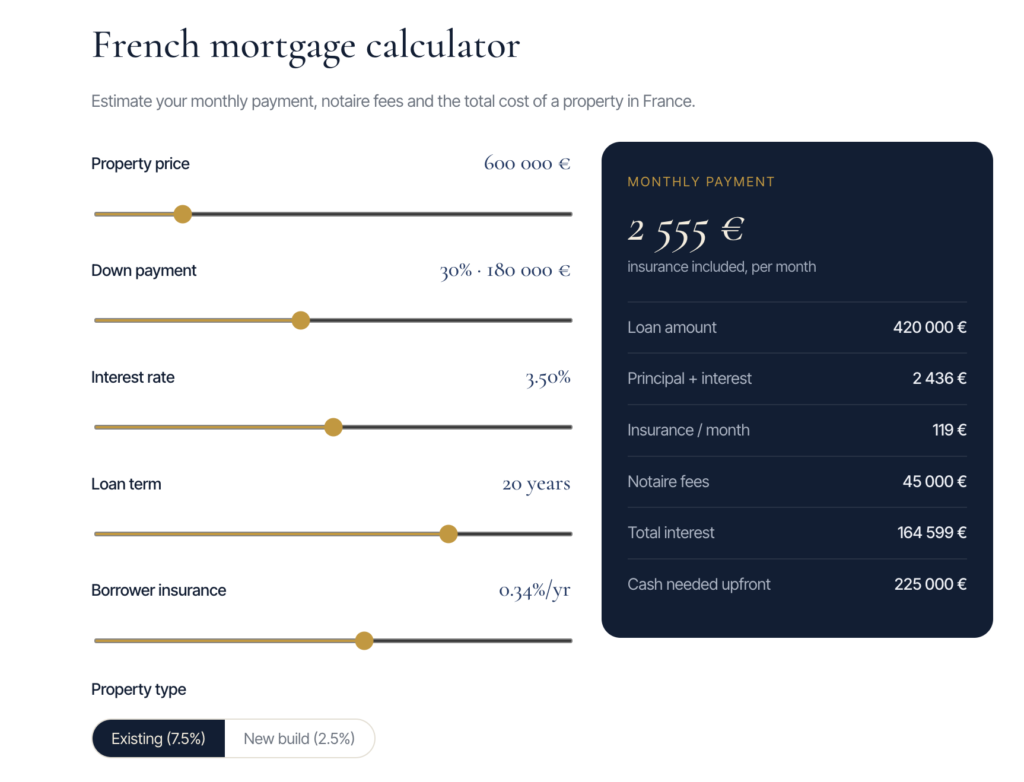
A French purchase is rarely just a mortgage decision. It involves the notaire’s fees (typically 7% to 8% on older properties), a potential renovation budget, furnishing, and the ongoing costs of holding a home in France. Building a financing plan that anticipates all of these, rather than only the loan itself, is what protects your peace of mind over the years that follow.
This is precisely the type of coordination our team handles end to end, with a trusted network of brokers, notaires, architects and trades already in place across the country. Ready to talk through your specific case? Our advisors on the ground can walk you through the numbers in plain English, without pressure.
Where this leaves you
French mortgage rates are unlikely to return to the historic lows of the previous decade. They are, however, entering a phase of relative stability that rewards well-prepared buyers and punishes hesitation. The most credible baseline points toward gradual easing, with meaningful room for surprise in either direction.
What matters most is not the headline number. It is the quality of your file, the coherence of your life project, and the ability to move with clarity when the right property appears. Rates set the frame; you paint inside it. With guidance from a team that lives and works in France, the frame becomes something you understand rather than something that constrains you, and your French home becomes a life project built on solid ground rather than on speculation about the next cycle.