





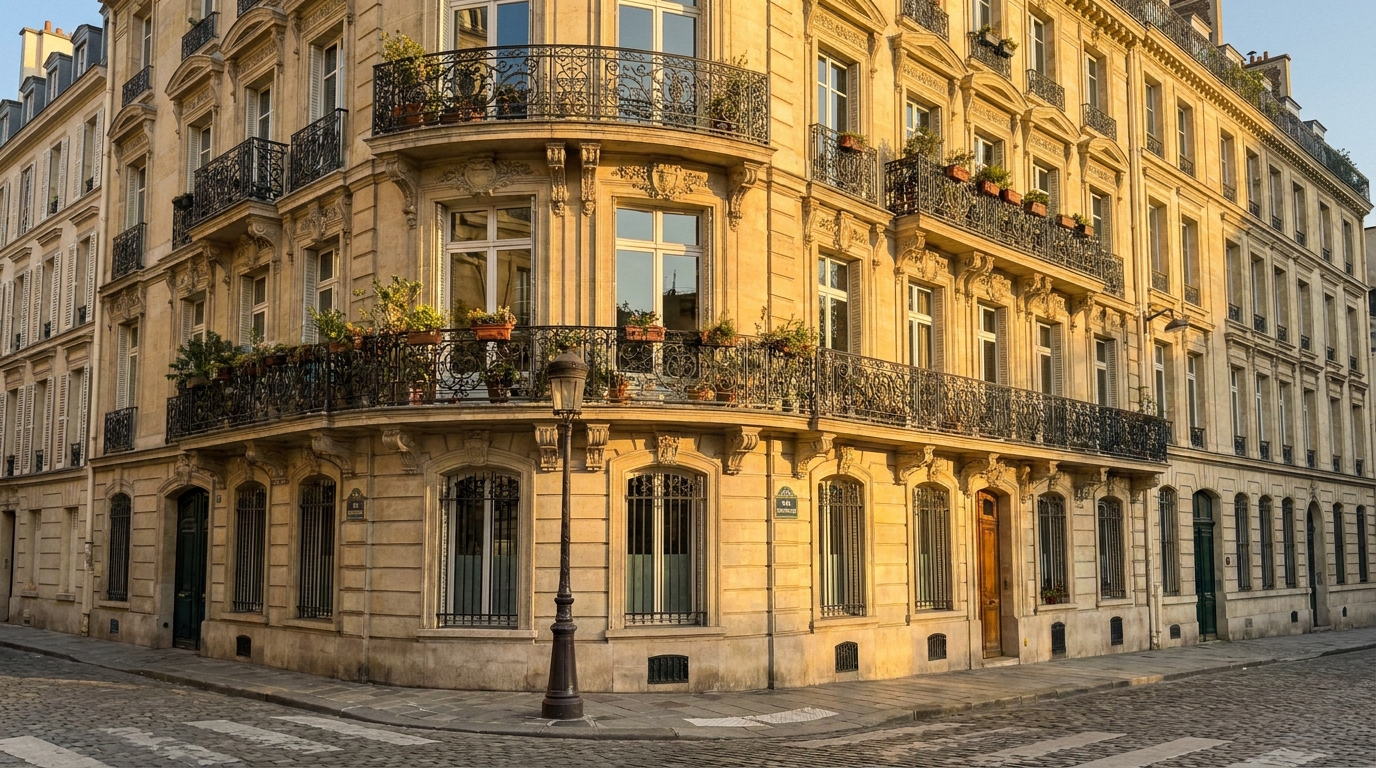

Ten thousand euros. That is roughly the average figure per square meter you will hear quoted for a Paris apartment today, and yet it tells you almost nothing about what you will actually pay. Two apartments on the same boulevard, both facing south, both freshly renovated, can trade for values that differ by 30% based on the floor, the view, the courtyard, and whether the elevator stops on your landing. If you are considering a pied-à-terre or a family home in the capital, understanding Paris property prices per square meter is the difference between negotiating from a position of clarity and paying tomorrow’s regret.
The Paris market has shifted. After years of near-vertical growth, the capital is now a buyer’s market in a way it has not been for a generation. Sellers are adjusting. Notaires are recording longer transaction timelines. And for international buyers who work with a team on the ground, the window is genuinely interesting.
Paris price per square meter at a glance
| SeLoger (€/m²) |
Meilleurs Agents (€/m²) |
10-year change |
|
|---|---|---|---|
| Apartment | €9,827 | €9,630 | +13.9% |
| House | €10,265 | €10,059 | n/a |
Sources: SeLoger (data to January 2026) and Meilleurs Agents (1 October 2026). The ten-year change is the Meilleurs Agents price index for Paris.
The Current Landscape: Reading Paris Prices Correctly
Averages hide more than they reveal. Before drilling into neighborhoods, it helps to understand how Parisian pricing is actually built and what a per-square-meter figure really represents in this city.
Apartments vs. Houses: Two Very Different Markets
Paris is overwhelmingly an apartment market. Roughly 90% of residential stock inside the périphérique consists of apartments in buildings ranging from Haussmannian to postwar concrete to contemporary. Median prices for apartments currently hover around 9,500 to 10,200 euros per square meter, with real transactions spanning from about 7,000 in the outer arrondissements to well above 18,000 in the most sought-after streets.
Houses, called maisons de ville or hôtels particuliers, are a different animal entirely. They are rare, coveted, and priced accordingly. A townhouse with a garden in the 16th or 7th arrondissement will often trade between 12,000 and 20,000 euros per square meter, and exceptional properties push considerably higher. Because supply is thin, comparables are harder to establish and negotiation demands a nuanced read of the market.
How the Per-Square-Meter Price Is Actually Calculated
The Parisian price per square meter follows the Loi Carrez, a legal measurement standard that excludes spaces under 1.80 meters of ceiling height, balconies, cellars, and parking. That distinction matters. A charming top-floor apartment with sloping mansarde ceilings may lose 10 to 15% of its apparent surface once Carrez rules are applied, which mechanically raises the price per square meter but not necessarily the value. The same square meter buys something very different elsewhere in Île-de-France.
Other factors weigh heavily: floor level, presence of an elevator, exposure to light, view, noise, the condition of the copropriété (the co-ownership structure of the building), and the energy performance rating known as the DPE. A poor DPE rating now shaves real money off asking prices, sometimes 5 to 10%.
→ Good to know
Always ask for the last three years of procès-verbaux (co-ownership meeting minutes) before making an offer. They reveal upcoming building works that can add tens of thousands of euros to your true cost.
Evolution Over Time: From Boom to Rebalancing
Paris prices climbed steadily for roughly two decades, then plateaued, then softened. Understanding that trajectory tells you where the leverage sits today.
The Long Climb
Between the early 2000s and the peak, Paris apartment prices roughly tripled. At the summit, the citywide average briefly exceeded 10,800 euros per square meter, and prime arrondissements crossed the symbolic 15,000-euro threshold on a routine basis. Foreign capital, low interest rates, and chronic undersupply drove the run.
The Correction
The market has since retreated by roughly 8 to 12% from its peak, depending on how you measure it. Rising interest rates cooled French buyer demand sharply, and sellers who had grown used to naming their price met a new reality. Transaction volumes fell before prices did, which is typical: sellers first refuse to move, then eventually accept the new equilibrium.
Where the Market Sits Now and Where It Is Heading
The current environment is one of measured stabilization. Well-priced properties in strong locations still sell within weeks. Overpriced listings sit for months. For international buyers, especially those paying in dollars or sterling, the combination of softer euro pricing and a rebalanced negotiation dynamic creates conditions we have not seen in a long time.
What comes next? Most credible forecasters expect a flat-to-modestly-positive trajectory over the coming years, with strong dispersion between neighborhoods. In other words, choosing the right street will matter more than ever.
Neighborhood by Neighborhood: Where the Value Sits
The Paris map is a mosaic. A five-minute walk can change price levels by 2,000 euros per square meter. Below is a synthesis of current ranges, drawn from recent transactions rather than asking prices. If safety is one of your criteria, our guide to safety and neighborhoods in Paris covers the same ground with official data.
The Prime Arrondissements
| Arrondissement | Character | Typical range (€/m²) |
|---|---|---|
| 6th (Saint-Germain) | Literary Left Bank, galleries | 14,500 to 19,000 |
| 7th (Invalides, Eiffel) | Grand apartments, embassies | 13,500 to 18,500 |
| 4th (Marais, Île Saint-Louis) | Historic core, boutique life | 13,000 to 17,500 |
| 8th (Triangle d’Or) | Luxury, business, hotels | 12,500 to 20,000+ |
| 16th (Passy, Auteuil) | Family classic, quiet, green | 11,000 to 16,000 |
These are the arrondissements where wealth stores itself. Values fluctuate less in downturns and recover first in upturns. If you are seeking a long-hold family asset with genuine Parisian character, this is where most of our clients ultimately land.
The Rising and In-Demand Districts
Other neighborhoods offer strong lifestyle appeal at more accessible price points. The 3rd (Haut Marais), the 9th (South Pigalle and around the Opéra), and parts of the 10th along the Canal Saint-Martin sit typically between 10,500 and 13,500 euros per square meter. They attract younger buyers, creative professionals, and international families who want a livelier daily rhythm.
The 11th, 12th, and 14th offer excellent value between 9,000 and 11,500 euros per square meter, with real neighborhood identity and often better renovation potential. The 15th, quiet and family-friendly, sits at similar levels with strong resale liquidity.
The More Accessible Arrondissements
The 18th (Montmartre being the exception at 11,000+), 19th, and 20th range roughly from 7,500 to 10,000 euros per square meter. Selection matters enormously here: a well-chosen street near a park or a metro hub behaves very differently from a block three minutes away.
→ On the ground
In Paris, the micro-location beats the macro-location every time. A quiet street in the 11th can outperform a noisy boulevard in the 6th, both for daily life and for long-term value.
Why Negotiation Now Matters More Than Ever
Paris has quietly become a negotiation market, and this is one of the most significant shifts of the current cycle. For international buyers who assume French sellers hold firm on price, the reality on the ground is very different. For American buyers, the practical path from first visit to residency is mapped out in our guide to moving to France from the US.
What the Numbers Say
Average discounts from asking price now run between 5 and 12%, depending on the arrondissement and the property’s condition. For apartments with a weak DPE rating, or requiring significant work, real transaction discounts of 15 to 20% are being documented. That is a meaningful shift from the market of just a few years ago, when many properties sold at or above asking within days.
Why Sellers Are Adjusting
Several forces are converging: French mortgage rates that reset buyer budgets, new energy regulations that penalize poorly rated properties, longer time-on-market, and a generation of sellers who inherited apartments and prefer to close a deal rather than wait indefinitely. Estate agents, aware that the market has turned, now often coach sellers to expect a serious counteroffer.
What this means for you is simple: the asking price is a starting point, not a verdict. The question is how to structure an offer that is respected, taken seriously, and lands the property at fair value.
The Anatomy of a Well-Built Offer
A credible negotiation rests on evidence and posture. It requires:
- Recent comparable transactions, drawn from notaire databases rather than portal asking prices.
- An honest technical read of the property: works needed, DPE trajectory, co-ownership health.
- A financing profile presented cleanly, whether cash or mortgage.
- An understanding of the seller’s motivation, which often shapes flexibility more than the property itself.
Get those four elements right and a Paris seller will listen. Skip them and you will either overpay or lose the property to a better-prepared buyer.
How a Buyer’s Agent Changes the Equation
Buying in Paris from abroad is not just about identifying an apartment. It is about reading a market that speaks another language, moves on its own timeline, and rewards those who know where the leverage actually sits.
What On-the-Ground Guidance Actually Looks Like
Our team lives and works in Paris. We visit properties in person, often before they are formally listed, through a trusted network of agents, notaires, and private sellers built over years. When you engage FRE, you are not scrolling portals from your kitchen at midnight; you are receiving curated files, video walk-throughs, honest assessments of light, noise, neighbors, and building condition, and a shortlist that respects your brief.
The Value We Add During Negotiation
This is where the difference becomes tangible. We build the comparable-transactions dossier that anchors your offer. We read the seller’s motivation, quietly, through channels no algorithm can access. We advise on the structure of the offer, including suspensive conditions, deposit level, and closing timeline, all of which influence how a French seller receives a price below asking.
On a 1.2 million euro apartment, a well-negotiated 8% reduction is nearly 100,000 euros. That is not a rounding error; it is a renovation budget, or a year of your children’s schooling, or the terrace furniture and the art on the wall.
→ The key point
A good buyer’s agent should save you more than they cost, in price negotiated and in mistakes avoided. Ask any prospective advisor to explain exactly how they will do both.
A Turnkey Path From Search to Keys
Beyond price negotiation, we handle the full choreography: the compromis de vente (the binding preliminary sales contract), the notaire coordination, the technical diagnostics, the mortgage brokerage if relevant, the works estimates if renovation is on the table, and eventually the interior design and furnishing if you want a turnkey home ready to walk into. Everything runs in English, on your timeline, remotely, with the reassurance that a real team is present at every step.
Budgeting Realistically for a Paris Purchase
The headline price is only part of the story. Paris transactions carry meaningful additional costs, and a clear budget prevents unwelcome surprises.
Acquisition Costs Beyond the Price
Notaire fees for existing property in France run roughly 7 to 8% of the purchase price. Agency fees, when paid by the buyer, add another 3 to 5%. A buyer’s agent mandate typically ranges between 2 and 5% depending on scope. All of this needs to sit inside your global budget before you shop.
Renovation and Furnishing
A cosmetic refresh of a Parisian apartment runs around 800 to 1,500 euros per square meter. A full renovation with kitchen, bathrooms, electrical, and plumbing rework climbs to 2,500 to 4,500 euros per square meter, and heritage buildings with fine moulures and parquet can require specialized craftsmanship that pushes higher. Furnishing a well-designed 80 square meter apartment typically lands between 40,000 and 90,000 euros depending on your taste.
Ongoing Ownership
Co-ownership charges in Paris average 30 to 60 euros per square meter per year, more if there is a concierge or elevator maintenance. Property taxes, insurance, and, if you rent short-term when absent, management fees complete the picture. None of this is prohibitive; it simply deserves to be modeled honestly from the start.
Bringing It Together
Paris remains one of the most enduring residential markets in the world. Prices per square meter are a starting language for reading it, but the real conversation happens at the level of the specific street, the specific building, the specific floor, and the specific seller across the table. The current cycle rewards buyers who arrive prepared, who negotiate with evidence, and who lean on people who actually know the ground.
Whether you are dreaming of a Haussmannian apartment above a leafy square, a Marais duplex with exposed beams, or a light-filled family flat near a park, the path from idea to keys is more navigable than it looks, provided you have the right partner beside you. Your Parisian art de vivre is a life project. Handled with care, it becomes exactly what you imagined, and often better.
Ready to explore what your budget really buys in Paris today? Reach out to the FRE team and we will build an honest, numbers-driven brief around your goals, with the peace of mind of a partner who lives here and speaks your language.