





UNITED STATES · ZILLOW
Is there a Zillow equivalent in France?
No Zillow, no MLS, no Zestimate. France has something Zillow has never had instead: the public register of every sale actually recorded. It is just scattered, in French, and nobody hands it to you.
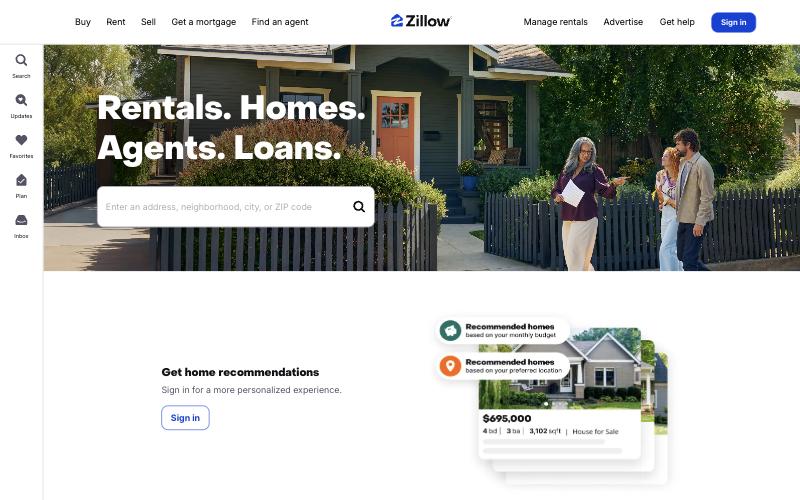
Here is a fact that surprises most American buyers: there is no Zillow in France, and the reason has nothing to do with technology. In fact, the French state publishes something Zillow has never had access to in the United States: a public, line-by-line registry of every property sale recorded by a notaire (the French public officer who authenticates all real estate transactions). It is called the DVF, short for Demandes de Valeurs Foncières, and it holds every address, surface, and price since the mid-2010s.
So why does buying a home in France still feel so opaque from New York, London, or San Francisco? Because the French data is better than what Americans are used to. It is simply scattered, in French, and never sitting conveniently next to the listings. The gap is not a missing website. The gap is a missing advocate whose mandate comes from you, the buyer.
Why Zillow Never Crossed the Atlantic
Zillow is a product of the American real estate ecosystem, and that ecosystem does not exist in France. Understanding this is the first step toward reading the French market with clarity.
How Zillow actually works in the United States
Zillow aggregates listings from the MLS (Multiple Listing Service), a cooperative database shared by American real estate agents at a local or regional level. On top of that feed, Zillow layers its famous Zestimate, an algorithmic valuation that updates as new sales come in, plus photos, tax history, school ratings, and messaging with agents. It is a one-stop shop because the underlying MLS is one-stop by design.
The platform operates meaningfully in the United States and Canada. It launched in the United Kingdom years ago and withdrew. It has never opened in France, Spain, Italy, Germany, or Portugal, and nothing on the public record suggests a French launch is in the pipeline.
The structural reason: France never built an MLS
French agencies do not pool their listings into a shared cooperative database. Each agency guards its mandates, and the same property can appear on three portals at three different prices, or on none of them at all. There is no single feed to plug a Zestimate into. There is no legal obligation to centralize listings. The market is deliberately fragmented, and the law protects the role of the notaire as the sole authenticator of a sale, which anchors the whole chain differently from the American title-and-escrow model.
Add to that two legal realities: strict data protection under European rules, and a culture where the sale price is a matter of public record only after the notaire has registered the deed. The Zillow business model, which depends on pre-sale listing aggregation plus modeled valuations, simply cannot be transplanted onto this foundation.
→ The FRE insight
If you are searching for “Zillow in France” and finding nothing useful, you are not missing a secret platform. You are hitting a structural reality of the French market, and the fix is a method, not a tool.
Side by side
Zillow against the five French tools, feature by feature
Zillow does six jobs in one product. France does the same six, split across five services, and wins outright on one of them.
| Feature | Our buyer’s agent | Zillow | SeLoger | Leboncoin | Bien’ici | MeilleursAgents | DVF (state) |
|---|---|---|---|---|---|---|---|
| Properties for sale | ✔ | ✔ | ✔ | ✔ | ✔ | ✔ | ✘ |
| Properties to rent | ✘ | ✔ | ✔ | ✔ | ✔ | ✔ | ✘ |
| Automated valuation | ✘ | ✔ | ✔ | ✔ | ✔ | ✔ | ✘ |
| Rent estimate | ~ | ✔ | ✔ | ✘ | ~ | ✔ | ✘ |
| Price per m² by area | ✔ | ✔ | ✔ | ✘ | ~ | ✔ | ✔ |
| Record of actual sold prices | ✔ | ~ | ~ | ✘ | ✘ | ✔ | ✔ |
| Agent directory or comparison | ~ | ✔ | ✔ | ✘ | ✔ | ✔ | ✘ |
| Mortgage tools | ~ | ✔ | ✔ | ✘ | ~ | ~ | ✘ |
| Owns a lending arm | ✘ | ✔ | ✘ | ✘ | ✘ | ✘ | ✘ |
| Rental application and rent payment | ✘ | ✔ | ✘ | ✘ | ✘ | ✘ | ✘ |
| Private seller listings | ✔ | ✔ | ✔ | ✔ | ~ | ✘ | ✘ |
| Covers the off-market | ✔ | ✘ | ✘ | ✘ | ✘ | ✘ | ✘ |
Features checked on each site on 9 October 2026. A tilde means the feature exists in a partial or indirect form, or that we could not confirm it without an account. DVF figures: explore.data.gouv.fr, data last updated April 2026. Zillow’s sold history comes from MLS and public records; the Zestimate is a model, DVF is a register of deeds, which is why the two are not the same thing. The buyer’s agent column answers a different question from the others: not whether our site has the feature, but whether you get the result working with us. We value a property by hand, for one address, which is not the same thing as an automated estimate.
See all French real estate websites →Talk to our buyer’s agents →
The Features Americans Love About Zillow, Mapped to France
American buyers typically arrive with a mental checklist built on Zillow habits. Let’s see what translates, what does not, and where the French equivalents actually live.
The all-in-one portal experience
Zillow combines listings, past sale history, mortgage simulation, agent reviews, and property messaging on a single page. In France, those pieces exist, but across four separate places: a listings portal, an estimation tool, the DVF registry, and the off-market segment that never appears online at all.
The Zestimate and its French cousins
The Zestimate is a model, trained on MLS data and public records, that produces a figure for almost any home. France has estimation tools too, built by portals and by independent firms, but they estimate from asking prices and modeled comparables, not from a universal MLS feed. They are useful as a sanity check and nothing more.
The French portals, one by one
Here is how the major French platforms compare to what you may be used to:
| Platform | What it is | What it lacks vs Zillow |
|---|---|---|
| SeLoger | The reference portal for agency listings, especially mid and upper market. | No integrated sale-history layer, no Zestimate equivalent on each listing. |
| Leboncoin | A generalist classifieds site where many private sellers list first. | Minimal filters, no verification layer, no valuation tools. |
| Bien’ici | A newer portal with strong map and 3D navigation. | Smaller inventory in rural regions, no public price history on each pin. |
| MeilleursAgents | An estimation tool with neighborhood price indices, now owned by a major portal. | Estimates, not registered sales; model-based, not registry-based. |
None of these alone replaces Zillow. Together, cross-read with the DVF, they come close, but only if you know how to combine them.
The Hidden Advantage: DVF, Better Than a Zestimate
Here is what almost no American buyer discovers in time: France publishes a resource Zillow has never had. The DVF is an open dataset released by the French tax administration and distributed through Etalab, the government’s open-data service.
What the DVF actually contains
Every sale authenticated by a notaire appears in the DVF: address, parcel reference, surface, number of rooms, type of property, and the final recorded price. Not an estimate. Not an asking price. The real transaction. This is a registry, not a model.
A Zestimate tells you what an algorithm thinks a home is worth. The DVF tells you what the neighbor’s house actually sold for. The gap in reliability is enormous, and it tilts in France’s favor.
Why no one has merged DVF with the listings
Legal and cultural barriers keep the two worlds apart. Portals cannot freely republish personal transaction data next to a live listing without risking privacy complaints, and agencies have little commercial interest in making their asking prices directly comparable to recent neighborhood sales. The data is public. The convenience layer is not.
→ Good to know
Before making an offer, pulling the DVF for the same street over the past three years will tell you more about fair value than any national index. It is the single most underused tool in the French market.
How to Read the DVF in Ten Minutes
The DVF is powerful, but it has traps. If you read it the wrong way, you will miscalculate what a property is worth by five to fifteen percent. Here is how to use it with confidence.
The three pitfalls every buyer should know
- The price is the deed price, excluding agency fees. If the DVF shows a sale at 480,000 euros, the buyer may have paid 500,000 or more once the agency commission was added. Compare like with like.
- The surface is the fiscal surface, not the Carrez measurement. The Loi Carrez is the legally measured habitable surface used in sales contracts for apartments. The DVF uses the tax-office surface, which can differ by several square meters. A price per square meter from DVF is not identical to a price per square meter from a listing.
- There is a lag of roughly six months. A sale closed in winter may only appear in the DVF the following summer. In fast-moving markets, you are reading recent history, not today’s price.
A practical reading method
Start with the exact street, then widen to adjacent streets, then to the quartier (neighborhood). Filter by property type and by a surface range close to the one you are considering. Discard outliers: a ground-floor studio with no light will skew the average, and so will a renovated top-floor apartment with a terrace. What you want is a cluster of five to ten comparable sales. That cluster is your anchor.
A concrete example
Imagine you are considering a two-bedroom apartment in a quiet neighborhood of Montpellier, listed at 395,000 euros for 72 square meters. The DVF shows twelve comparable sales on the same block over the past two years, clustered between 4,600 and 5,200 euros per square meter. Your target apartment is being offered at roughly 5,480 euros per square meter. That premium may be justified by a renovation, a view, or a parking space, or it may simply be an ambitious ask. The DVF does not negotiate for you, but it tells you where to start.
Where the French Market Actually Lives
Once you accept that there is no single platform, the market opens up into four distinct territories. Learning to move between them is the real skill.
The public listings layer
SeLoger, Leboncoin, Bien’ici, and a few regional sites hold the visible inventory. This is where most international buyers spend their time, and it is also where competition is highest, because every other foreign buyer is reading the same pages.
The estimation layer
MeilleursAgents and similar tools offer neighborhood price indices and model-based valuations. Treat them as directional, never as proof. They are useful to spot a trend, not to defend an offer.
The registry layer
The DVF, accessed through Etalab or a handful of community-built viewers, is the ground truth. It is where you move from “what sellers hope to get” to “what buyers actually paid”.
The off-market layer
This is where a meaningful share of quality properties change hands in France, especially in sought-after villages, Parisian arrondissements, and parts of Provence and the Southwest. These homes are shown through private networks: local agents who know a seller is thinking about it, notaires handling an inheritance, neighbors with a word to pass along. No portal, French or American, will ever surface this layer. It requires people on the ground.
→ On the ground
In many desirable areas, the property that fits you will never appear online. It will reach you through a trusted network, days or weeks before a listing is even considered.
What We Use Instead at FRE
Our method is not a replacement for Zillow. It is what a serious buyer uses when the market has no single portal and the best inventory sits off-screen.
A buyer’s advocate, not a listings machine
The core difference is the mandate. Portal agents work for the seller. A buyer’s agent, or chasseur immobilier, works for you, with a written mandate, aligned incentives, and a duty of advice. That alignment changes everything, from how a property is presented to how an offer is defended.
The toolkit we actually combine
For every search, we cross-read the public portals, the estimation indices, the DVF for comparable sales, and our own trusted network of local agents, notaires, and private sellers. We also factor in the technical layer that no portal shows cleanly: the DPE (energy performance diagnostic), the condition of the copropriété for apartments (the co-ownership structure), zoning rules, and planned public works. These details move prices by tens of thousands of euros and never appear on a listing summary.
A realistic budget frame
For international buyers, we generally see three ranges: a renovation project in a village in the Southwest or inland Provence between 150,000 and 350,000 euros, a turnkey second home on the coast or in a popular town between 400,000 and 900,000 euros, and a Paris pied-à-terre starting around 500,000 euros for a small, well-located apartment. Within each range, the DVF plus local knowledge decides whether a given listing is a fair deal or a stretch.
Eight Questions Buyers Ask Us About the Data
Will Zillow ever launch in France?
There is no public plan, no announced date, and no structural reason to expect it soon. The absence of an MLS and the strength of European privacy law make the business case difficult.
Is the DVF really free and public?
Yes. It is distributed by the French state through Etalab and mirrored by several community tools. It is free to consult.
How accurate is a MeilleursAgents estimate?
Directionally useful at the neighborhood level, often imprecise at the individual property level. Use it as a cross-check, never as the only source.
Can I buy in France entirely online?
You can search and even sign preliminary documents remotely, but the final deed is authenticated by a notaire, and physical or delegated presence is required. A power of attorney handles this cleanly when organized in advance.
What is the difference between a Zestimate and the DVF?
A Zestimate is a model that predicts a price. The DVF is a registry of prices actually paid. The DVF is more reliable because it is not a prediction.
Why do the same properties appear at different prices on different portals?
Because agencies hold independent mandates and sometimes revise prices at different speeds, and because some listings are duplicated or mandated to several agencies at once. Always verify through a direct conversation.
How do I access the off-market segment from abroad?
Through a buyer’s agent with an active local network. There is no online shortcut; the information lives in relationships.
Do I need a buyer’s agent if I speak some French?
Language is only one layer. The deeper value is in reading the market, negotiating with sellers’ agents who know the local dynamics, and navigating the legal and technical steps with a notaire. Many buyers who speak French still choose to work with an advocate for exactly these reasons.
The Takeaway for Your French Home Project
The absence of a Zillow in France is not a weakness of the French market. It is a feature of a system where the real transaction data is publicly available, the legal chain is anchored by the notaire, and a meaningful share of the best inventory moves through human networks rather than algorithms. The country offers more reliable raw data than most buyers realize. What it does not offer is a single page where everything is pre-digested in English.
That gap is where a trusted partner on the ground changes the outcome of your project. Reading the DVF, calibrating against the right comparables, filtering the public portals, and opening the off-market layer are not tasks for a weekend of online research. They are the day-to-day craft of a local team whose mandate comes from you. If buying a home in France is part of your art de vivre, the right question is no longer “where is the French Zillow”. It is “who, on the ground, reads this market for me”. That is the conversation we are built for, and it is where your French home project begins with clarity and peace of mind.
Keep reading
The other portals we have put under the same lens
Each of these pages takes a platform international buyers already know and asks the same question: what is the French equivalent, and where does it stop being enough.
Start here
Choosing the right French property website
The ten platforms that matter in France, what each is actually good for, and how to read them.
United States
Realtor.com in France
Why an MLS-fed portal cannot exist here, and what replaces the Realtor experience.
United Kingdom
Rightmove equivalent in France
Britain has one dominant portal. France has five, and none of them is complete.
Spain
Idealista France
The Spanish giant opened idealista.fr in September 2026. What it changes, and what it does not.
United States
Craigslist in France
Why classifieds never took the same shape here, and which French site plays that role.
Next step
Stop refreshing portals. Start with a brief.
Tell us the region, the budget and the life you are planning around it. We will tell you what that buys today, what the portals are not showing you, and whether we are the right team.