





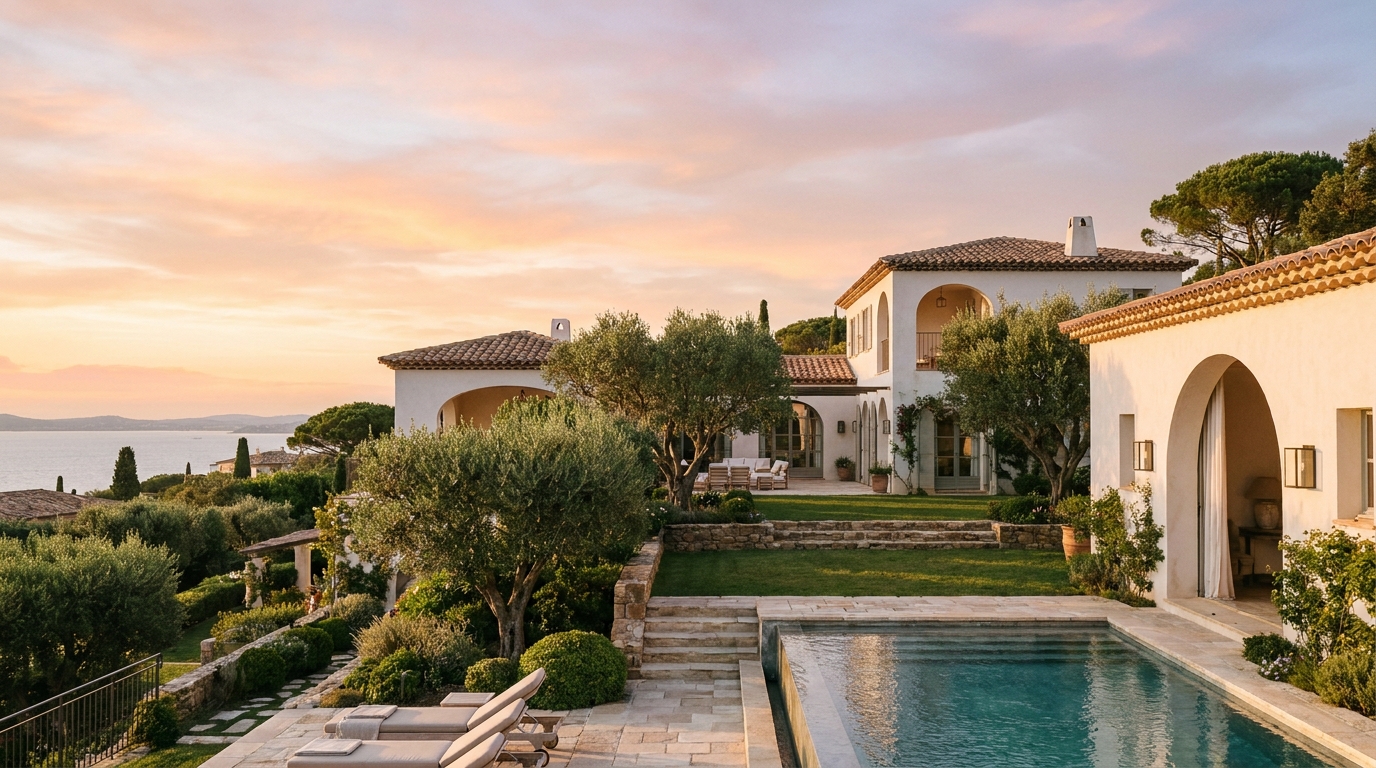

Few names in real estate carry the pull of Saint-Tropez. A fishing village turned global icon, where a stone cabanon behind the citadel can trade for the price of a Parisian penthouse, and a waterfront villa in Les Parcs can quietly change hands for the price of a small chateau. So what are you actually paying for, when you look at Saint-Tropez property prices per square meter today, and how do you avoid overpaying in a market that is finally, and quietly, shifting?
The short answer: the headline numbers hide enormous variation, negotiation has come back into the conversation, and local knowledge on the ground matters more than any online estimate. Let’s break it down.
Saint-Tropez price per square meter at a glance
| SeLoger (€/m²) |
Meilleurs Agents (€/m²) |
10-year change |
|
|---|---|---|---|
| Apartment | €11,270 | €11,128 | +21.5% |
| House | €21,810 | €21,426 | +27.1% |
Sources: SeLoger (data to January 2026) and Meilleurs Agents (1 October 2026). The ten-year change is the Meilleurs Agents price index for Saint-Tropez.
Reading Saint-Tropez Property Prices Per Square Meter Today
Saint-Tropez remains one of the most expensive municipalities in France, alongside a handful of Parisian arrondissements and a few Alpine resorts. But averaging the whole peninsula into a single figure is misleading. The gap between a village apartment and a seafront villa is not double or triple; it can be tenfold.
Average price ranges for apartments
For apartments inside Saint-Tropez itself, current market ranges typically fall between 12,000 and 22,000 euros per square meter, with a broad average around 15,000 to 17,000 euros. A studio in the village, tucked into a narrow lane behind the port, will often trade in the lower band. A renovated two-bedroom with a terrace and a sea view, or a foot in the water on the Ponche, can climb well past 25,000 euros per square meter.
Condition matters enormously. A tired apartment with dated electrics and a mediocre DPE (the French energy performance rating, similar to an American home energy score) will price very differently from a turnkey unit with a private outdoor space and a proper parking spot, which is a rare luxury in the historic center.
Average price ranges for houses and villas
Houses show the widest spread. A village house on the hillside might sit between 14,000 and 20,000 euros per square meter. Move to a villa with land, a pool, and privacy in one of the sought-after districts, and you enter a different world: 20,000 to 40,000 euros per square meter is common, and prime waterfront properties in Les Parcs de Saint-Tropez routinely exceed 50,000 euros per square meter, with trophy assets pushing higher still. It is worth putting these figures next to the rest of Provence-Alpes-Côte d’Azur before you commit.
Land size, pool, sea view, exposure and the quality of the build carry more weight here than raw surface area. A 200 square meter villa on a flat, walled plot with mature pines and southern exposure is a very different asset from a 200 square meter house on a slope with no view, even if the price per square meter looks similar on paper.
Why the “average” figure can mislead you
Aggregated statistics blend everything into one number, but no one actually buys “the average”. You buy a specific property, on a specific street, with a specific orientation. Two neighbors on the same road can sell for prices that differ by 30 to 40 percent, based on renovation quality, plot configuration and how well the sale was negotiated.
→ The FRE insight
Ask for the last three comparable sales on the same street, not just the asking prices currently listed. Asking prices tell you what sellers hope for; completed sales tell you what the market actually pays.
How Prices Have Evolved Over Time
Saint-Tropez has always run its own cycle, less correlated with the broader French market than most people assume. It responds more to international liquidity, currency shifts, and lifestyle demand than to interest rate moves in Paris.
The long climb and the recent plateau
Over the past two decades, prices in Saint-Tropez have roughly tripled in the prime segments. The most intense acceleration came during the post-lockdown years, when demand for large properties with outdoor space and privacy pushed villa prices to record levels. That surge peaked, and the market has since entered a plateau, with a modest correction on the highest-priced assets.
Turnkey villas in prime areas held their value best. Properties needing significant work, or those with awkward layouts, no view, or poor energy ratings, have seen the sharpest price adjustments, sometimes 10 to 15 percent below the peak.
What the current cycle tells us
Transaction volumes have thinned. Buyers are more selective, financing costs are higher than they were, and international buyers are more measured in their offers. Sellers who priced ambitiously are sitting on their properties longer, and the average time on market for high-end villas has stretched considerably. Saint-Tropez sits on our map of southern France, which places each area in context.
This is the quiet backdrop to a market that still, from the outside, looks bulletproof. The listings look glamorous. The prices per square meter still make headlines. But behind the scenes, well-advised buyers are negotiating in a way that would have been unthinkable a couple of years ago.
A comparison at a glance
| Segment | Typical price per sqm | Current market tone |
|---|---|---|
| Village apartment, average condition | 12,000 to 16,000 € | Room for negotiation |
| Renovated apartment with view/terrace | 18,000 to 25,000 € | Resilient, selective demand |
| Villa, residential district, with pool | 18,000 to 28,000 € | Negotiation of 5 to 12 percent common |
| Prime villa, Les Parcs / waterfront | 35,000 to 60,000 €+ | Thin volumes, thoughtful offers welcomed |
The Most Sought-After Neighborhoods
Location inside Saint-Tropez is where the biggest premiums are paid. The peninsula is compact, but each area has its own personality, price point and buyer profile.
Les Parcs de Saint-Tropez
This gated domain on the eastern side of the peninsula remains the undisputed prime address. Private access to the coastal path, direct or near-direct sea frontage, mature grounds and a level of discretion that money alone doesn’t always buy. Villas here regularly transact above 40 million euros, with per-square-meter prices that put Les Parcs among the most expensive residential zones in Europe. We cover the same districts from a security angle in our guide to safety and neighborhoods in Saint-Tropez.
La Ponche and the historic village
The oldest quarter of Saint-Tropez, wrapped around the old fishing port. Narrow streets, pastel facades, restored fishermen’s houses. Prices here are driven by rarity: very few properties come to market, and turnover is slow. A restored house with a rooftop terrace and a glimpse of the sea can command 20,000 to 30,000 euros per square meter or more.
Les Salins, La Moutte and Capon-Pinet
These are the residential districts of choice for families and long-stay owners. Larger plots, calmer atmosphere, closer to the beaches of the eastern peninsula. Prices generally sit between 18,000 and 30,000 euros per square meter for villas, with genuine variation based on plot, view and quality of build.
The village hillsides and the citadel area
For those who want to walk to the port in five minutes and live inside the fabric of Saint-Tropez, the streets around the citadel offer village houses with character, sometimes with small gardens or terraces facing the bay. Prices span a wide range depending on renovation status.
→ On the ground
Two streets apart, the same square meter can cost 30 percent more or less. Walk the neighborhood at different hours before you fall in love with a floor plan; noise, light and privacy tell you more than any brochure.
Why Negotiation Matters More Than Ever
The Saint-Tropez market has always had a reputation for being tight on price. That reputation is now partly outdated. In the current cycle, negotiation is not just possible; it is essential.
The shift in bargaining power
Inventory has grown. Some properties have been on the market for eighteen months or longer. Sellers who initially resisted any discount are now, quietly, open to structured offers. This is particularly true for:
- Villas priced above 10 million euros, where the buyer pool is naturally smaller.
- Properties with dated interiors or a mediocre DPE.
- Houses with awkward plots, difficult access or no pool.
- Sellers who have already bought elsewhere and need to close.
A well-argued offer, backed by comparable sales and a clear rationale, can secure discounts of 5 to 15 percent on advertised prices. On some assets, more. This isn’t about lowballing; it is about pricing the property correctly against what the market actually clears.
What a good negotiation actually looks like
Negotiation in France is a written process, anchored in the compromis de vente, the preliminary sales contract that binds both parties once signed. Everything before that signature is where the value is created or lost.
A strong negotiation combines three elements: solid market data, a clear reading of the seller’s motivation, and the discipline to walk away. It also requires the right posture. The French market rewards buyers who feel serious, prepared, and respectful of local codes. An offer delivered the right way, through the right channel, with the right supporting arguments, will land very differently from a cold email with a number attached.
The renovation lever
Many properties in Saint-Tropez need work: energy upgrades, layout reworking, pool refurbishment, garden redesign. Factoring realistic renovation costs into your offer, with quotes from local trades, is one of the strongest negotiation tools available. A property presented as “ready to move in” but requiring 400,000 euros of updates is not the same asset as its asking price implies.
How a Buyer’s Agent Changes the Outcome
Buying in Saint-Tropez remotely, or even in person as a foreign buyer, is a specialized exercise. The properties that matter are often not on public portals. The right notaire, the right architect, the right pool company: these relationships are not searchable online.
Access to the real inventory
A meaningful share of Saint-Tropez transactions happen off-market. Owners in the prime segments value discretion. Properties circulate through a trusted network of local agents, notaires and private introductions long before, or entirely without, appearing on a public listing. Being introduced into that flow is the first advantage of working with an on-the-ground team.
Independent valuation and negotiation
Your agent works for you, not for the seller. That alignment matters when it comes to establishing the fair value of a property, structuring an offer, and negotiating the compromis de vente. It also matters during due diligence, when questions around urbanism, coastal law, servitudes, flood zones and construction permits can materially affect what you’re actually buying.
A turnkey process, handled in English
From the first search brief to the day you receive the keys, and often well beyond into renovation and furnishing, the process is handled for you. Property visits, video tours, notaire coordination, tax structuring, currency transfers, inspection reports: every step is managed by a team that lives here and works in your language.
→ Worth knowing
A buyer’s agent fee is typically a small fraction of the negotiation savings alone, before you even count the value of avoided mistakes on due diligence and renovation planning.
The value of local craftsmanship
A Saint-Tropez property is only as good as the trades that maintain and improve it. The finest villas on the peninsula are the work of builders, gardeners, pool specialists and interior craftsmen who have spent decades refining their trade in this specific climate and light. Access to that art de vivre, the culture of doing things properly, is one of the quiet luxuries of buying with a team that has genuine roots here.
Bringing It All Together
Saint-Tropez property prices per square meter tell you where the market sits, but they don’t tell you what to pay for a specific property. That answer lies in the details: the street, the orientation, the plot, the condition, the seller’s story, and the way the offer is built and delivered. The current cycle rewards buyers who take their time, work with proper local guidance, and treat the purchase as the serious life project it is.
If you’re thinking about a home on the peninsula, the ingredients of a good outcome are the same as they have always been: clarity on your brief, honest data, patience, and a trusted network on the ground. What has changed is that, for the first time in years, there is real room to negotiate, and real value in doing so well. Would you rather rely on an online estimate, or on a team that walks these streets every week? Reach out when you’re ready to talk about your French home; we’ll bring the market to you, and handle the rest with the peace of mind you deserve.