







Imagine signing a contract to build a house 5,000 miles from home, in a language you don’t fully speak, with a builder you’ve met twice. Then imagine that this contract, if drafted correctly, legally obliges the builder to deliver your home on a fixed date, at a fixed price, with a bank standing behind the promise. That is the quiet strength of French construction law. It was written to protect buyers who cannot be on site every day, and it works especially well for international clients who are building their French home from abroad.
French building contracts are not a formality. They decide what happens if the builder disappears, if the roof leaks three years in, if the walls crack after seven. Reading them properly, and choosing the right one from the start, is the single most important decision of your build.
What protects you when you build a house in France?
Four instruments do the heavy lifting, and they work together. Understanding each one is what separates a smooth build from a stressful one.
The contract itself
The contract fixes the price, the delivery date, the plans, and the payment schedule. In France, the strongest version is the Contrat de Construction de Maisons Individuelles (CCMI), a regulated contract designed for individual homes built on your land.
The mandatory guarantees
French law layers four guarantees on top of the contract: parfait achèvement (one year), biennale (two years), décennale (ten years), and dommages-ouvrage insurance that pre-funds repairs. These are not optional add-ons; they are structural.
The garantie de livraison
Specific to the CCMI, this bank-backed guarantee ensures that if your builder goes under mid-build, another contractor finishes the house at the agreed price. For a buyer who is not on site, this is the backbone of peace of mind.
The seven-day withdrawal right
After signing, you have seven calendar days to walk away, no justification needed. It is the law’s built-in cooling period, and it applies even if the ink is dry.
The three ways to build, and what each one protects
There is no single French building contract. There are three distinct legal paths, and each one offers a different level of protection. The choice is not about architectural style; it is about how much legal armor you want around your project.
CCMI: the regulated, protective route
The CCMI is the most protective framework in French residential construction. The builder commits to a fixed price, a fixed delivery date, and penalties for late delivery. The payment schedule is capped by decree. The garantie de livraison is mandatory. For a client building remotely, this is usually the right starting point.
Maîtrise d’œuvre: more freedom, less automatic protection
Under a maîtrise d’œuvre setup, you hire an architect or project manager who coordinates separate trades on your behalf. You sign individual contracts with each trade. This path gives you more design freedom and often more creative control, but there is no single bank guarantee covering a mid-build failure. If a key trade goes bankrupt, you absorb the gap. It can work beautifully, provided you have strong local coordination.
VEFA: buying off-plan
The Vente en l’État Futur d’Achèvement (VEFA) is not a build contract in the strict sense. You buy a property that does not yet exist, from a developer, and ownership transfers in stages as construction progresses. VEFA is common for apartments and some developer-led house projects. It has its own payment schedule, its own guarantees, and its own logic.
The VEFA payment schedule is capped by article R261-14 of the Construction Code: no more than 35 percent of the price at completion of the foundations, 70 percent once the building is water-tight, 95 percent at completion, and the balance when the keys are handed over. That balance can be held in escrow if the property does not match the contract.
→ The seven mistakes buyers make in VEFA
- Confusing delivered with finished. A VEFA handover gives you a shell with standard fittings, almost no storage, and the developer’s default finish list. Plan a fit-out budget from the day you reserve, not after the keys.
- Accepting the showroom menu. The choice is usually three tile shades, two kitchen models and white paint. It is a catalogue, not a design brief.
- Accepting the imposed partner trades. Developer-nominated kitchen fitters and contractors narrow your options, stretch lead times, and often cost more than going direct.
- Asking for changes too late. Travaux modificatifs acquéreur (buyer-requested modifications) must be filed before the shell is closed, ideally at reservation. Every late request raises both the price and the delivery date, and anything touching the structure or the ventilation will simply be refused.
- Underestimating the fit-out envelope. A full interior fit-out runs roughly 400 to 700 euros per square meter excluding furniture and appliances, so 24,000 to 40,000 euros on a 60 m² apartment. A bespoke kitchen alone starts around 5,000 to 8,000 euros, and engineered or solid parquet 60 to 120 euros per square meter laid.
- Not asking who pays the taxe d’aménagement. It is computed on the developer’s building permit and can be passed on in the price. Balconies, covered loggias, annexes above 5 m² and covered parking can all count towards it.
- Not reading the general conditions on delivery. They usually spell out how each modification request shifts the delivery date, which is the clause that decides whether your handover lands in month eighteen or month twenty-four.
Our Ynspir design studio has published the full list of VEFA fit-out traps, in French: aménager un logement neuf en VEFA.
→ The FRE insight
If you already own the land and want a house built on it, CCMI is almost always the safer legal frame. If you are drawn to a custom design with trades you want to choose yourself, maîtrise d’œuvre can work, but only with experienced local coordination.
How much can a builder ask you to pay, and when?
This is where buyers get caught off guard. Under CCMI, article R231-7 of the French Construction Code sets a strict ceiling on what percentage of the price can be called at each stage. A builder cannot ask for more, no matter how persuasive the request.
The payment schedule the law imposes
Here is the maximum cumulative percentage the builder can bill at each milestone under CCMI:
| Construction stage | Maximum cumulative % of price |
|---|---|
| Opening of the site | 15% |
| Completion of foundations | 25% |
| Completion of walls | 40% |
| Water-tight structure (roof on) | 60% |
| Partitions, air-tightness | 75% |
| Installation of equipment, plumbing, heating, carpentry | 95% |
| Handover (réception) | 100% (minus 5% if reserves) |
The deposit: 3% or 5%
Before the works start, the builder can ask for a deposit. The maximum is 3% of the price if works begin within one year of signing, and 5% if later. Any deposit must be held in a secured account or backed by a bank guarantee. A builder asking for 10% upfront is operating outside the law.
The 5% held back
At réception, if you have raised reserves (defects to be fixed), you are legally entitled to hold back 5% of the total price until those reserves are lifted. That money sits in an escrow account, usually with the Caisse des Dépôts. It is a powerful lever, and one that too many buyers forget to use.
The garantie de livraison, and why it only exists under CCMI
This is the guarantee that answers the fear every absent buyer carries: what if the builder goes under?
How it works
Before the first shovel breaks ground, the CCMI builder must produce a garantie de livraison issued by a bank or an approved insurer. The guarantor commits to covering any overrun on the agreed price and to funding a replacement contractor if the original one defaults. The guarantee is attached to your contract and must be produced before you sign.
Why it does not exist outside CCMI
Under maîtrise d’œuvre, there is no equivalent single-point guarantee. Each trade carries its own insurance, but no bank underwrites the overall completion of the house. If a plumbing company fails halfway through, you find a new one and manage the extra cost. This is the quiet but decisive difference between the two routes.
Your seven-day right to withdraw
French law gives you a cooling-off period that few other legal systems match in residential construction.
How the clock starts
Once the signed CCMI reaches you by registered mail, you have seven calendar days to withdraw without penalty and without reason. The deposit, if already paid, is returned in full. No builder can shorten this delay, and no clause can override it.
How to use it well
Use those seven days. Have the contract reviewed by someone fluent in both the French construction code and your native language. Check the plans, the price breakdown, the delivery date, the penalty clauses, and the identity of the guarantor. If anything is unclear, this is the moment to raise it.
La réception: the handover that starts every clock
Réception is the single legal act that triggers almost every guarantee. The day you accept the house, four separate clocks start running. It deserves full attention.
Procès-verbal and réserves
At handover, you sign a procès-verbal de réception. On this document, you list every réserve, every defect or unfinished item you want corrected. Anything not listed is, in principle, accepted. A door that does not close properly, a tile that is cracked, paint that is uneven: write it down.
Why you should be represented, even from abroad
If you cannot physically attend, you can mandate a representative to receive the house on your behalf. For a client building remotely, having a trusted local advisor walk the house with a detailed checklist is not a luxury. It is what turns a signature into real protection.
→ On the ground
A thorough réception walkthrough typically takes two to three hours. Rushing it to catch a flight is the most expensive mistake you can make at the end of a build.
Conditional handover and refusal
If the defects are major, you can refuse réception entirely, or accept it with reserves and withhold 5% of the price. The withheld amount is deposited with the Caisse des Dépôts and released only when every reserve is lifted.
The four guarantees, not two
Many buyers hear about the décennale and assume that is the whole picture. In reality, French law stacks four guarantees on top of each other, each covering a different category of risk.
- Garantie de parfait achèvement (1 year): covers every defect you report during the first year after réception, whether listed as a reserve or discovered later.
- Garantie biennale (2 years): covers equipment that can be removed without damaging the structure, such as shutters, boilers, built-in appliances.
- Garantie décennale (10 years): covers structural damage and anything that makes the house unfit for its purpose, from foundations to a leaking roof.
- Dommages-ouvrage insurance: pre-funds décennale repairs so you do not wait for a court ruling to get the work done.
What dommages-ouvrage actually solves
Without dommages-ouvrage, a serious structural defect would force you to sue, wait for liability to be assigned, and only then see the money. With it, the insurer pays first and sorts out responsibility later. It is mandatory for the owner to subscribe to it, and it transfers to future buyers if you sell within ten years.
RE2020: the standard your house must meet
French construction is governed by a strict environmental standard that affects both design and cost.
What RE2020 requires
The Réglementation Environnementale 2020 sets limits on energy consumption, carbon footprint during construction, and summer thermal comfort. Fossil-fuel heating is effectively excluded for new builds. Insulation levels are high, air-tightness is tested, and the carbon content of materials is measured.
What it means for your budget
A RE2020-compliant house costs more to build than an older-generation home of the same size, often by 5 to 10%. In return, you get lower running costs, a stronger resale value, and a DPE (energy performance diagnostic) in the top tier. That matters for comfort, and increasingly for the French resale market.
When it goes wrong
Even with the strongest contract, projects hit turbulence. The question is how the system responds.
Delays and late-delivery penalties
CCMI contracts include pénalités de retard, usually set at 1/3000 of the total price per day of delay. On a €400,000 build, that is around €133 per day. The penalty is automatic, not negotiated.
Disputes and the expert judiciaire
If a serious disagreement arises, the usual next step is a court-appointed expert judiciaire, an independent technical expert who inspects the work and issues a binding assessment. Most disputes are resolved before trial, on the basis of the expert’s report.
→ Good to know
Keep every email, every photo, every signed document in a single shared folder from day one. In a French construction dispute, documented evidence is what carries weight.
How this maps to the US system
For American buyers, French construction law can feel both reassuring and unfamiliar. A quick comparison helps anchor it.
| Element | United States (typical) | France (CCMI) |
|---|---|---|
| Contract type | Negotiated, varies by state | Regulated by national code |
| Payment schedule | Agreed between parties | Capped by decree (R231-7) |
| Completion guarantee | Performance bond, optional | Garantie de livraison, mandatory |
| Structural warranty | Usually 10 years, varies | Décennale + dommages-ouvrage, mandatory |
| Cooling-off period | Rare for new builds | 7 days, by law |
| Energy standard | State-level codes | RE2020, national |
The French system is more prescriptive and more protective. There is less room to customize the contract itself, but far more automatic safety built into the law.
FAQ
What is a CCMI contract in France?
A CCMI (Contrat de Construction de Maisons Individuelles) is a regulated French building contract used when a single builder constructs a house on land you already own. It fixes the price and delivery date, caps the payment schedule by law, and requires a garantie de livraison issued by a bank. It is the most protective framework in French residential construction.
What is dommages-ouvrage insurance?
Dommages-ouvrage is an insurance policy that the owner is legally required to subscribe to before construction begins. It pre-funds repairs for any damage covered by the garantie décennale, so you do not need to wait for a court to assign liability before works start. It stays attached to the property for ten years and transfers to any future buyer.
What is VEFA in France?
VEFA (Vente en l’État Futur d’Achèvement) is a legal framework for buying a property off-plan. You purchase a home that does not yet exist, from a developer, and you become the owner progressively as construction advances. VEFA has its own staged payment schedule and its own set of guarantees, and it is most common for apartments and developer-led house programs.
Its staged payments are capped by law, and its pitfalls are mostly about finishes rather than structure. Our Ynspir studio covers them in detail: how to fit out a new-build VEFA apartment (in French).
What does the garantie décennale cover?
The garantie décennale covers, for ten years after réception, any damage that affects the structural solidity of the house or that makes it unfit for its intended use. That includes foundations, load-bearing walls, roofs, waterproofing, and major equipment integrated into the structure. It does not cover normal wear and tear, nor purely aesthetic defects such as paint fading or small surface marks that do not affect the function of the building.
What happens if the builder goes bankrupt mid-build?
Under a CCMI, this is precisely what the garantie de livraison is designed for. The guarantor (a bank or approved insurer) steps in, appoints a replacement contractor, and covers any extra cost needed to finish the house at the originally agreed price. You pay nothing more than the price written into your contract. Outside the CCMI framework, under a maîtrise d’œuvre setup, there is no equivalent single-point guarantee, which is why the choice of contract matters so much from the start.
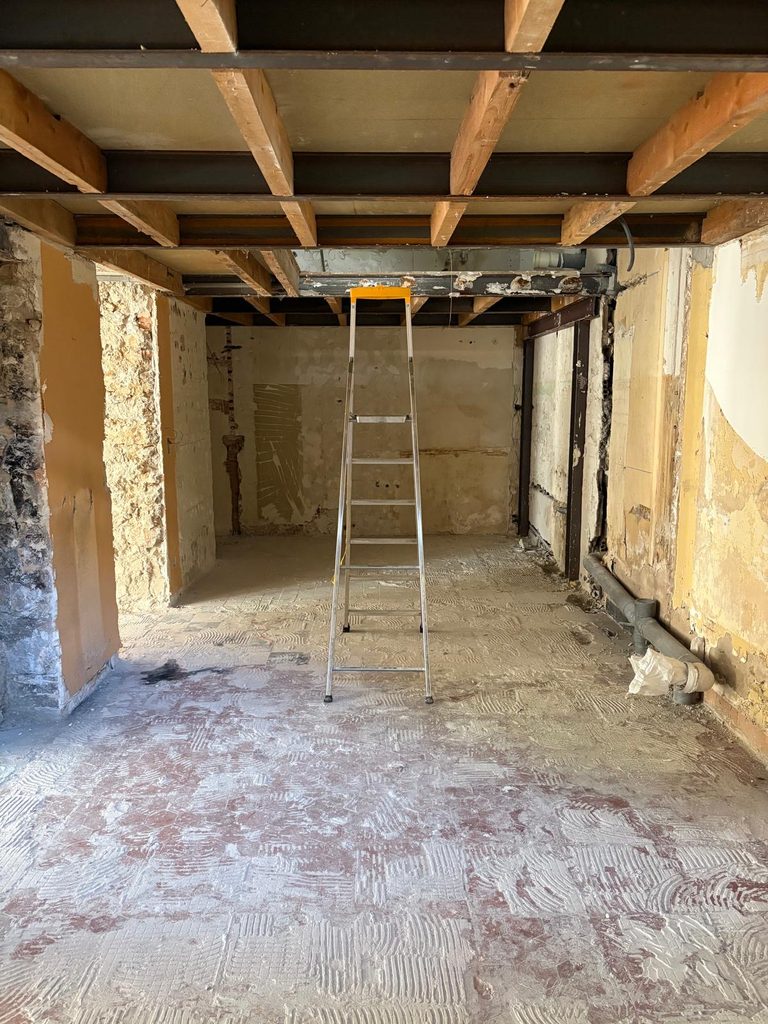
Building your French home with the right contract behind you
French building contracts are, in many ways, a quiet gift to international buyers. The law has already written in most of the protection you would otherwise have to negotiate. Capped payments, mandatory guarantees, a seven-day cooling period, a bank standing behind completion: these are not promises made by a brochure, they are rules enforced by the Construction Code.
What makes the difference, especially from abroad, is having the right people translate those rules into daily reality. Reading the garantie de livraison clause carefully before signing. Walking the house at réception with a clipboard and a trained eye. Keeping the paper trail that will matter five years from now if a tile moves or a wall cracks.
That is where a trusted network on the ground, fluent in both the French legal frame and your expectations as an owner, turns a complex build into a calm one. Your French home deserves that clarity from the first signature to the last stone laid. Shall we talk about your project?