





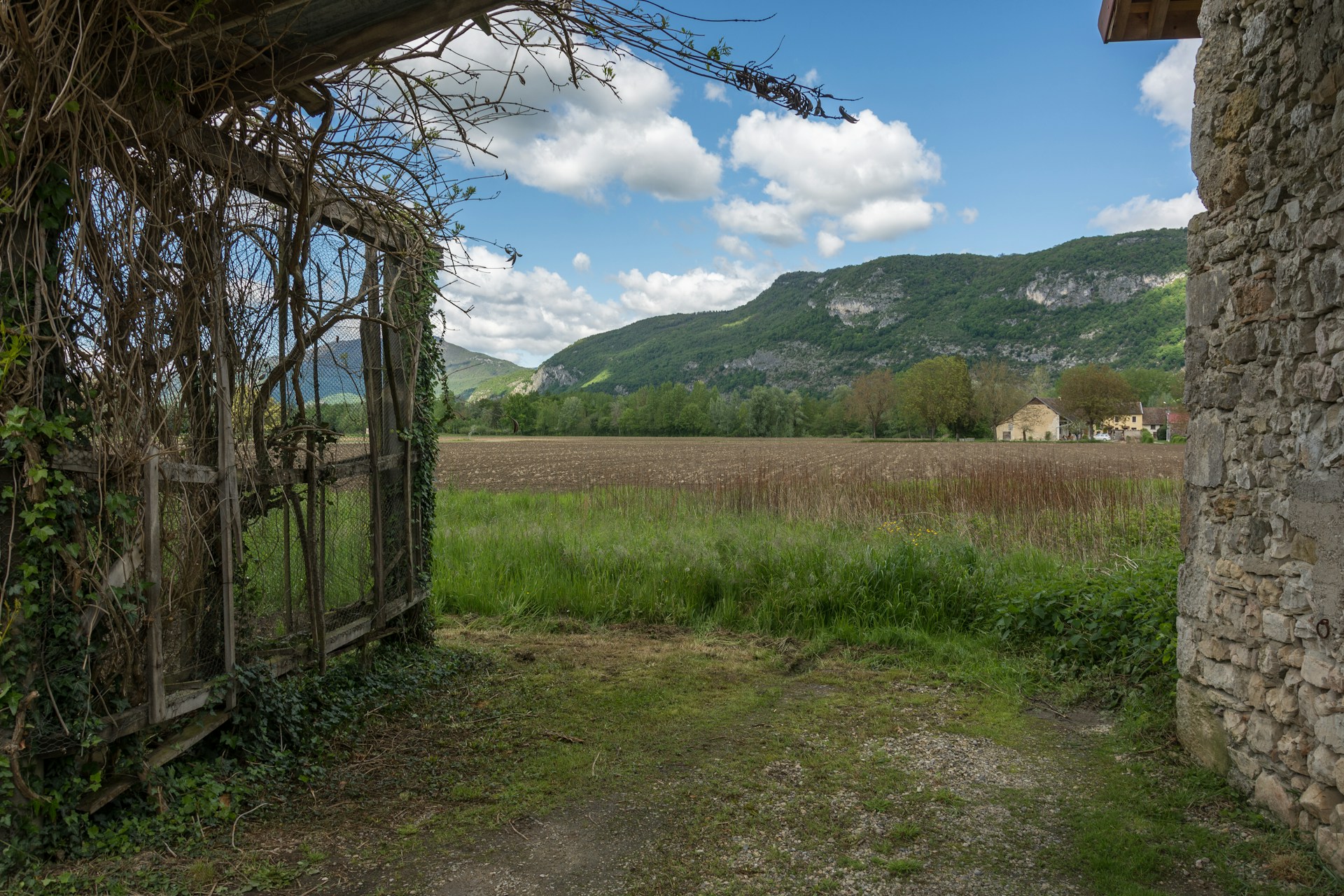

A plot of French countryside, a view of vineyards, the quiet certainty that you will design your home from scratch. The idea is seductive, and perfectly achievable. But in France, land does not come with a built-in promise. A field that looks ready for a foundation might legally be farmland. A gentle slope by a village might sit inside a protected zone. And the mairie, the local town hall, might have a quiet say in who ends up as the owner.
Buying building land in France rewards patience and the right local reflexes. Here is what you need to know before you sign anything, from zoning codes to pre-emption rights, soil studies, and the real cost of turning a plot into your French home.
Can foreigners buy land in France?
Yes. France places no restriction on nationality when it comes to acquiring real estate, land included. There is no residency requirement, no need for a French passport, no cap on the number of plots you can own. The restrictions, when they exist, apply to the land itself, never to the buyer.
In your own name, jointly, or through an SCI
You can hold the plot personally, jointly with a spouse or partner, or through a Société Civile Immobilière (SCI), a French civil property-holding company often used by couples, families, or groups of investors to simplify succession and shared ownership. Each structure has tax and inheritance consequences that your notaire, the public officer who handles every French real estate transaction, will walk you through before you commit.
What buying land does not give you
Ownership of a plot does not automatically grant you the right to build on it. That right flows from the local urban-planning rules, not from the title deed. A plot might be yours entirely and still remain legally un-buildable. This single distinction surprises more international buyers than any other.
How do you know if land can be built on?
Three documents answer that question, and reading them properly is where local knowledge earns its keep.
Terrain constructible and the PLU codes
A terrain constructible is, quite simply, land zoned for construction. Each French commune publishes a Plan Local d’Urbanisme (PLU), the local zoning plan, which divides the territory into zones with coded names. Zone U covers urbanized land, usually buildable. Zone AU covers areas earmarked for future urbanization. Zone A is agricultural. Zone N is natural and protected. The letters matter more than any seller’s assurance.
The certificat d’urbanisme
Before you commit to a plot, you or your notaire can request a certificat d’urbanisme from the mairie. Two versions exist. The informational one tells you which rules apply to the parcel. The operational one, called CU opérationnel, tests a specific building project against those rules and freezes the regulatory framework for eighteen months. For a buyer planning a build, the operational version is the one that offers real clarity.
Reading the cadastre
The cadastre is the national land registry, publicly accessible online. Each parcel has a reference number, a shape, and a surface area. Cross-checking the cadastre with the PLU map tells you exactly where your plot sits, what it borders, and which zone it falls into. A trained eye also spots access issues, easements, and awkward boundaries before the compromis de vente, the preliminary sales contract, is drafted.
→ Good to know
Ask the mairie whether the PLU is currently under revision. A plot that is buildable today can be reclassified tomorrow, and the opposite is equally true.
How much is land in France?
Prices vary enormously by region, proximity to a town, view, and services already in place. Here are realistic ranges per square meter for a serviced, buildable plot:
| Region | Typical range (€/m²) | Context |
|---|---|---|
| Rural Dordogne, Lot, Creuse | 30 to 80 € | Larger plots, villages, slower markets |
| Normandy, inland Brittany | 60 to 150 € | Close to the coast raises prices sharply |
| Provence, inland | 150 to 350 € | Village plots command a premium |
| Côte d’Azur, Luberon villages | 400 to 1 500 €+ | Scarcity drives prices |
| Greater Paris, Lyon ring | 300 to 900 € | Small parcels, strong demand |
What drives the price
Three factors matter above all: whether the plot is already connected to water, electricity, and sewage; whether access to a public road is already secured; and the slope and soil quality. A terrain viabilisé, meaning already serviced, can cost 15 000 to 40 000 € more than a raw equivalent, but it saves you months of coordination.
Hidden costs beyond the asking price
Count on notaire fees of roughly 7 to 8% on a bare-land purchase, higher proportionally than on a built property. Add the soil study, the surveyor, connection fees to utilities if the plot is raw, and the taxe d’aménagement, a one-off development tax levied once your building permit is granted. For an average detached house, that tax lands between 2 000 and 8 000 €.
Can you build on agricultural land in France?
As a rule, no. Zone A is reserved for agricultural activity, and construction is tightly restricted to buildings necessary for farming operations, usually by a registered farmer. For a private buyer dreaming of a country home on a sunflower field, the answer is almost always a disappointed no.
The rare exceptions
Some communes allow limited exceptions for an existing farmhouse to be renovated or extended, or for an agricultural dwelling tied to a genuine farming project. A few PLUs include small sub-zones marked Ah or Nh where a specific, modest construction may be allowed. These are narrow doors, and they open only after a detailed review of the local rules.
Buying farmland as a non-farmer
You can buy agricultural land, but SAFER, the regional agricultural land agency, has a pre-emption right on most such transactions. Its mission is to keep farmland in agricultural use. Non-farmers who buy a field purely to admire the view, without a building right, may end up with exactly that: a lovely field, and no permit forever.
Pre-emption rights: the mairie and SAFER can take your plot
This is the detail that rarely appears in English-language searches, and it catches buyers off guard.
The commune’s right of pre-emption
Many communes hold a Droit de Préemption Urbain (DPU) over plots inside their urban zones. When a seller signs a compromis, the notaire sends a Déclaration d’Intention d’Aliéner (DIA) to the mairie. The town hall then has two months to step in and buy the plot itself, at the agreed price, for a public-interest project. If it exercises its right, the original buyer walks away empty-handed.
SAFER on rural and semi-rural parcels
SAFER’s pre-emption applies mostly to agricultural land but can also touch parcels on the edge of villages, orchards, vineyards, and plots with substantial unbuilt surface. Its intervention is less common than DPU but very real, especially in wine regions.
→ On the ground
Before you fall for a plot, a quick phone call from a local advisor to the mairie often reveals whether pre-emption is a realistic risk here, or purely theoretical. That five-minute conversation can save months.
The soil study, and the surprises it prevents
Since recent legislation, a soil study called étude G1 is mandatory on plots sold for individual construction in zones with clay-shrinkage risk, which covers nearly half of France. The seller provides it. A more detailed étude G2, commissioned by the buyer, is strongly recommended before finalizing foundation plans.
What a soil study reveals
Clay movement, groundwater levels, bedrock depth, slope stability. On a problematic soil, foundations can shift from a standard slab to deep piles, adding 15 000 to 50 000 € to the construction budget. Better to know before signing.
Who pays, and when
The G1 is included with the sale. The G2 costs 1 500 to 3 500 € and is paid by the buyer, usually once a compromis is signed and the plot is under a suspensive condition. A conclusive G2 often changes the architect’s design.
The notaire, the géomètre, and who does what
Several professionals come into play, and clarity on their roles helps you move faster.
The notaire
The notaire is a public officer, impartial, who drafts and authenticates the deed, collects taxes and fees, checks title, and runs the pre-emption notifications. The same notaire can represent both parties, or each side can bring their own at no extra cost since the fee is split between them.
The géomètre-expert
The géomètre-expert is a licensed land surveyor. On a sale of building land in a lotissement, meaning a formally subdivided development, French law requires a bornage, a precise boundary survey, before signature. On isolated plots, it is optional but very wise. A bornage typically costs 1 000 to 2 500 €.
The architect or constructeur
For a build above 150 m² of floor area, an architect is legally required. Below that, you can work with a constructeur de maisons individuelles, a dedicated home-builder, or a general contractor. Each path has its own contract framework and guarantees.
Why the ten-day cooling-off period does not protect a land purchase
French law gives buyers of a residential property a ten-day right to withdraw after signing the compromis, with no justification needed. On bare land intended for construction, that protection is limited. Case law has drawn fine distinctions, and buyers often assume a safety net that is not fully there.
The conditions suspensives your compromis must carry
What truly protects you are the suspensive conditions written into the preliminary contract. These clauses let you walk away, deposit returned, if a specific event does not occur. For a building-land purchase, insist on at least:
- Obtaining a building permit (permis de construire) matching your project
- No exercise of pre-emption by the mairie or SAFER
- A favorable certificat d’urbanisme opérationnel
- Satisfactory soil study (étude G2)
- Confirmed access to water, electricity, and sewage within a defined budget
- Mortgage approval if you are financing the plot
Without these clauses, a signed compromis commits you fully. With them, you keep the right to withdraw if the project cannot proceed on the terms you need.
→ The key point
The quality of a land purchase is decided in the drafting of the compromis, not at the signing of the final deed. Every protection you want must be written in before you sign the first contract.
Where building plots actually come from
Not every good plot is listed online, and the quietest ones are often the best.
Lotissements and public listings
Formal subdivisions, developed by professionals or communes, offer the simplest route: boundaries are set, services are in, rules are clear. You will find them on major portals and through local real estate agents. Expect a premium of 10 to 25% over an equivalent raw plot.
Private sales, divisions, and off-market plots
Many building plots come from private landowners dividing a larger garden, from estates being settled, or from villagers who decide to sell a corner of family land. These rarely reach national websites. They surface through a local network, a conversation at the mairie, a word with a neighboring farmer. This is where on-the-ground presence changes what you can access.
How FRE sources plots for international buyers
Our team lives and works in France, with a trusted network of notaires, surveyors, architects, local agents, and private sellers across the regions we cover. We handle the full process remotely in English: identifying buildable plots that match your life project, running the zoning and pre-emption checks, negotiating, coordinating the soil study, framing the compromis with the right suspensive conditions, and running the build with vetted craftsmanship on the ground. The result is a turnkey path from first search to the keys of your French home.
FAQ
Can foreigners buy land in France?
Yes, without restriction linked to nationality or residency. You can hold the plot personally, jointly, or through an SCI. The constraints, when they exist, come from local zoning rules and pre-emption rights, which apply equally to French and foreign buyers.
Can I buy land in France as an American?
Absolutely, and the process can be handled almost entirely from the United States. Practically, you will want a French bank account to receive and send funds locally, a secure international wire for the deposit and balance, and often a procuration, a notarized power of attorney, so your notaire or representative can sign the deed on your behalf. On the US side, remember that foreign real estate is not reported on FBAR unless held through a foreign entity, but rental income or an eventual sale must be declared to the IRS. A cross-border tax advisor is a wise early call.
How much does it cost to buy land in France?
Beyond the price of the plot, budget 7 to 8% for notaire fees, 1 000 to 2 500 € for a boundary survey, 1 500 to 3 500 € for a detailed soil study, and 15 000 to 40 000 € for utility connections if the plot is not serviced. The taxe d’aménagement, collected after your building permit, usually runs 2 000 to 8 000 € for a standard home.
How much is an acre of land in France?
One acre equals 4 047 m². In rural inland regions, an acre of buildable land might cost 120 000 to 320 000 €. In Provence or along the coast, the same acre can reach 1 to 4 million €. Keep in mind that French zoning typically caps how much of a plot you can actually build on, often 20 to 40% of the surface, so an acre is rarely built out in full.
Can you build on agricultural land in France?
Generally no. Zone A land is reserved for agricultural use, and construction is restricted to buildings genuinely tied to farming activity. Non-farmers can buy agricultural land, subject to SAFER’s pre-emption right, but should not expect to obtain a building permit for a private residence. Rare exceptions exist in specific sub-zones, and they require careful reading of the local PLU before any commitment.
From a plot of French land to your French home
Buying building land in France is one of the most rewarding ways to shape a home that truly reflects you, from the orientation of the terrace to the stone chosen for the facade. It also asks more of a buyer than purchasing an existing property: zoning codes to decode, pre-emption rights to clear, soil to test, contracts to draft with care. Every one of these steps is manageable with the right guidance and the right local relationships.
If a plot in France is on your mind, whether in a Provençal village, a quiet Dordogne valley, or a coastal corner of Brittany, our team is here to walk through your project with you, in English, from first conversation to the day you break ground. Reach out when you are ready, and let us bring the clarity and peace of mind that a life project of this scale deserves.