






Picture this: you’ve found the perfect plot in the Dordogne, a south-facing parcel with old oaks and a view toward a limestone ridge. Now the real question lands on the table. What will it actually cost to build the house you’ve been drawing in your head for years? The short answer, before we go deeper, is this: expect 1,800 to 2,500 € per square meter for a standard build, 2,500 to 4,000 € per square meter with an architect, and a total of 450,000 to 700,000 € for a 150 m² home in the southwest once land, taxes, and fees are included.
That range covers most realistic scenarios, but the cost of building a house in France is shaped by far more than the price per square meter. Land, VAT, connection fees, the notaire (the public officer who handles property transactions), yearly taxes once you move in: each line matters. Let’s walk through them with the clarity you need to make a confident decision.
How Much Does It Cost to Build a House in France?
The honest answer depends on three variables: who builds it, where you build, and how finished you want it from day one. A turnkey constructor’s catalog home is not the same product as an architect-designed house with bespoke joinery and local stone, and the numbers reflect that.
Cost per Square Meter by Build Type
Here is how the French market usually breaks down for a new build, excluding land and taxes:
- Catalog or constructeur house: 1,500 to 1,800 € per m². Standard finishes, limited customization, fastest timeline.
- Mid-range custom build: 1,800 to 2,500 € per m². Better insulation, upgraded kitchen and bathrooms, some design flexibility.
- Architect-designed home: 2,500 to 4,000 € per m². Tailored plans, premium materials, local craftsmanship.
- High-end or heritage-style build: 4,000 € per m² and above. Hand-cut stone, bespoke carpentry, period details.
The architect fee itself typically runs 8 to 12% of the construction budget and is mandatory for any home above 150 m² of surface area.
Cost by Region
Regional variation is significant. Labor rates, material logistics, and local demand all push the numbers up or down.
| Region | Standard build (€/m²) | Architect build (€/m²) |
|---|---|---|
| Southwest (Dordogne, Lot, Gers) | 1,700 to 2,200 | 2,500 to 3,500 |
| Provence and Côte d’Azur | 2,200 to 2,800 | 3,200 to 4,500 |
| Brittany and Normandy | 1,600 to 2,000 | 2,400 to 3,200 |
| French Alps (chalet construction) | 2,800 to 3,800 | 4,000 to 6,000 |
| Loire Valley | 1,800 to 2,300 | 2,600 to 3,600 |
Is It Expensive Compared with the US?
For most American buyers, French construction looks reasonable per square meter but comes with a different mix of taxes and procedural fees. A 150 m² (roughly 1,615 sq ft) architect-designed home in the Dordogne, fully delivered, often lands between 500,000 and 650,000 €. The equivalent custom build in a comparable rural setting in the United States would frequently exceed that, especially once land, permits, and finishes are tallied. The French build often rewards you with thicker walls, better insulation standards, and materials that age gracefully.
→ The FRE insight
Ask any quote to be presented TTC (all taxes included) rather than HT (before tax). The 20% VAT gap can distort your comparison if you’re reading two bids side by side.
How Much Does a Small House Cost to Build?
Small is a relative word in French construction, and the 150 m² threshold is the real pivot point in your planning. Below it, your options widen. Above it, the architect becomes mandatory and the budget climbs.
The 80 to 120 m² Range
A compact family home in this range typically costs 160,000 to 300,000 € for the build alone, depending on region and finishes. It’s the sweet spot for retirees, a second home for two, or a pied-à-terre with a guest room. You keep flexibility, you avoid the architect obligation, and you can still deliver something elegant with real character.
Why 150 m² Is the True Threshold
French law requires that any new construction with a floor area above 150 m² be designed by a registered architect. This isn’t a formality. It changes your budget structure, your timeline, and the level of detail in your plans. Many buyers deliberately land at 148 or 149 m² to stay below the line, especially if the design is relatively straightforward. Others embrace the architect route for a home that will truly feel one of a kind.
Chalet Construction in the Alps
If your French home project is a chalet, the numbers shift. Mountain logistics, snow-load requirements, local timber traditions, and the premium placed on alpine real estate push costs to 2,800 to 4,500 € per m² for a quality build, and 5,000 to 7,000 € per m² for high-end chalets in Megève, Chamonix, or Courchevel. A 120 m² chalet rarely lands under 400,000 € once everything is counted.
What the Land Costs
Land is the variable with the widest spread, and it often shapes the final budget more than the build itself. A hectare of farmland in the rural Gers may trade for 15,000 €, while a modest plot with a sea view in the Var can exceed 500,000 €.
Rural vs. Village vs. Coastal
In rural southwest France, serviced building plots of 1,500 to 3,000 m² typically run 40,000 to 90,000 €. Inside village boundaries, closer to amenities, expect 80,000 to 180,000 € for a smaller parcel. On the Mediterranean coast or near sought-after Provence villages, the same surface area can easily cross 300,000 €, and in some locations the land outweighs the construction cost.
Serviced or Not Serviced
A plot described as viabilisé is already connected to water, electricity, sewage, and often telecoms. A non-serviced plot (non viabilisé) is cheaper on paper but can add 10,000 to 25,000 € once you factor in the connection work. Always ask for the certificat d’urbanisme and confirm what is included before signing.
The 20% VAT Nobody Mentions
New construction in France carries 20% VAT, applied to the full build cost. On a 400,000 € construction, that is 80,000 € in tax built into the price. Most quotes from reputable builders already include it, but the figure deserves to be stated plainly because it reshapes how you compare a new build with an existing-home purchase.
Why Existing Homes Can Feel Cheaper
When you buy an older home, you pay transfer taxes of around 7 to 8% through the notaire, but no 20% VAT on the price itself. That alone is often why a renovation project looks more attractive on paper than a new build, even when the work ends up substantial.
When Reduced VAT Rates Apply
For renovations on homes older than two years, VAT can drop to 10% or even 5.5% for certain energy-efficiency work. New construction, however, almost always sits at the full 20%. Factor it in from the start.
→ Good to know
When comparing a new build to a renovation, run both totals including every tax and fee. The gap between the two options is often smaller than it first appears.
Taxes and Connection Costs People Forget
A build quote is only part of the picture. Several French-specific costs land on top, and they can add 10 to 15% to your total project.
Taxe d’Aménagement
This development tax is not a percentage of your build cost. It is calculated on the floor area of the new construction, multiplied by a flat per-square-meter value set nationally and revised every January, then by a communal rate of 1 to 5% and a departmental rate of up to 2.5%. For a 150 m² house, expect somewhere between 6,000 and 15,000 €. One detail catches second-home buyers out: the 50% reduction on the first 100 m² applies only to a main residence, so a holiday home pays the full base on every square meter. The tax is triggered by your building permit, and declared within ninety days of completion.
Viabilisation
Connecting a non-serviced plot to the main networks typically costs 8,000 to 20,000 €. Water, electricity, sewage, and fiber each have their own connection fee, and the distance from your plot to the main line matters a lot. On a remote parcel, this line can balloon.
Notaire Fees on the Land Purchase
When you buy the land, the notaire levies transfer taxes and fees of around 7 to 8% of the land price. On a 100,000 € plot, that is 7,500 € or so. This fee covers the public officer’s work, the title search, and the taxes paid to the state.
Architect and Design Fees
If you work with an architect, budget 8 to 12% of the construction cost. On a 400,000 € build, that is 32,000 to 48,000 €. For complex projects or protected sites, the share can rise to 15%.
Insurance
The dommages-ouvrage insurance is legally required for new construction. It protects you if structural defects appear within ten years. Expect 2 to 3% of the construction cost, so 8,000 to 12,000 € on a mid-range build. Skipping it is not a real option: without it, reselling within the first decade becomes complicated.
What You Will Pay Every Year Once It Is Built
Few conversations about construction cover the recurring costs, and yet these shape your long-term relationship with your French home.
The Two-Year Taxe Foncière Exemption
New builds benefit from a two-year exemption on taxe foncière (property tax). You must declare the completion of the construction within 90 days to qualify. Miss that window and you lose the exemption entirely. After two years, taxe foncière typically runs 800 to 2,500 € per year for a 150 m² house, depending on the commune.
Taxe d’Habitation on Second Homes
The taxe d’habitation has been abolished for primary residences, but it still applies to second homes. In high-demand communes (most of coastal France, Paris, popular villages in Provence and the southwest), the local council can apply a surcharge of up to 60% on top of the base rate. Realistically, a 150 m² second home can carry 1,500 to 4,000 € per year in combined local taxes.
The 90-Day Declaration Window
Within 90 days of completion, you must file a déclaration H1 at the tax office. This document confirms the characteristics of your home and triggers the correct taxation. Late filing can cost you both the exemption and future adjustments. It is one of the simplest administrative steps to handle well, and one of the most expensive to overlook.
→ On the ground
We handle the 90-day declaration for clients who are not in France when the house is delivered. It takes an afternoon with the right paperwork, and it protects two years of tax savings.
Three Worked Budgets
Numbers are easier to trust when you see them assembled on a real project. Here are three realistic scenarios for international buyers.
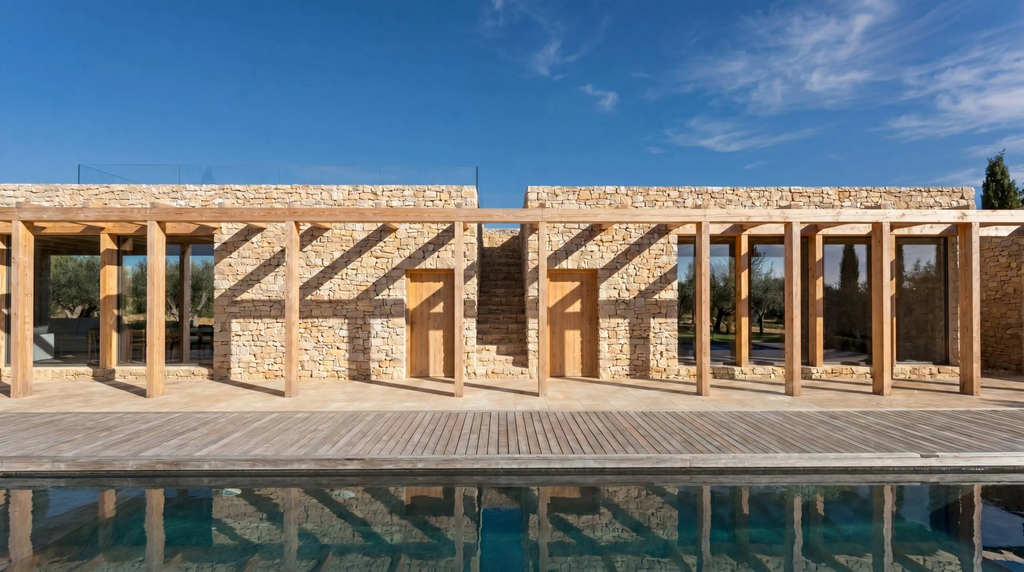
Southwest, 150 m² Stone-Clad Family Home
- Land (serviced plot, 2,000 m² near a Dordogne village): 85,000 €
- Notaire fees on land: 7,000 €
- Construction (architect-designed, 2,800 €/m²): 420,000 €
- Architect fees (10%): 42,000 €
- Taxe d’aménagement: 10,000 €
- Dommages-ouvrage insurance: 10,000 €
- Total: approximately 574,000 €
Provence, 150 m² Contemporary Villa
- Land (serviced, 1,500 m² inland from Aix): 220,000 €
- Notaire fees: 17,000 €
- Construction (3,400 €/m², architect, high-quality finishes): 510,000 €
- Architect fees (10%): 51,000 €
- Taxe d’aménagement: 13,000 €
- Insurance: 12,000 €
- Total: approximately 823,000 €
Brittany, 110 m² Coastal Cottage
- Land (small plot, village near the coast): 95,000 €
- Notaire fees: 7,500 €
- Construction (standard quality, 2,000 €/m²): 220,000 €
- No mandatory architect (under 150 m²), design fees: 8,000 €
- Taxe d’aménagement: 6,500 €
- Insurance: 6,000 €
- Total: approximately 343,000 €
How to Keep the Budget Under Control
Even the best-planned project will meet surprises. The point is to design the budget so those surprises stay manageable.
Build a 10% Contingency From Day One
Soil conditions, access roads, unexpected utility runs: every build site has its quirks. Setting aside 10% of the construction cost as a formal reserve protects your peace of mind and your timeline. If you don’t use it, you have margin for upgraded finishes.
Decide What Can Wait
Not everything needs to be done before you move in. Landscaping, a swimming pool, outbuildings, solar panels: all can be phased over two or three years. Prioritize the envelope, the insulation, the roof, and the kitchen. The rest can breathe.
Work with Trades Who Know Your Region
Local artisans know which stone weathers well in the Lot, which roof pitch handles mistral winds, which insulation suits a coastal climate. Our trusted network of regional builders and craftsmen is the quiet backbone of every FRE project. Would you like to talk through your own scenario? We can model the real numbers for your plot and your plans.
FAQ
How Much Does It Cost to Build a House in France?
Expect 1,800 to 2,500 € per m² for a standard build and 2,500 to 4,000 € per m² for an architect-designed home. A fully delivered 150 m² house in the southwest, land and all fees included, typically lands between 450,000 and 700,000 €.
How Much Does It Cost to Build a Small House in France?
A compact home of 80 to 120 m² usually costs 160,000 to 300,000 € for the construction alone. Add land, taxes, and fees, and total project costs often sit between 280,000 and 450,000 € depending on region.
How Much Does It Cost to Build a Chalet in France?
Chalet construction in the Alps runs 2,800 to 4,500 € per m² for quality builds, and 5,000 to 7,000 € per m² for high-end projects in prestige resorts. A 120 m² chalet, land excluded, rarely falls below 400,000 €.
What Is the Average Price of a House in France?
The national average for an existing home sits around 3,000 € per m², with wide regional variation. New construction averages higher because of VAT and modern energy standards. Rural France remains notably more affordable than the Paris region or the Côte d’Azur.
Are Houses Cheaper in France Than in the United States?
In most rural and small-town areas of France, yes, especially when you compare per square meter. The build quality, materials, and energy performance are typically strong. The gap narrows in high-demand coastal and alpine regions, where land values climb sharply.
Building in France is a life project, not a transaction. The numbers above give you a solid frame, but the real work begins when you match the budget to a specific plot, a specific region, and a specific vision of how you want to live. A quiet morning on the terrace in the Dordogne, the smell of pine from the Alps, the light at the end of a Provençal afternoon: these are what the budget is really for. When you’re ready to turn those images into blueprints and signed contracts, our team on the ground is here to walk the plot with you, read the quotes, and bring the whole project to turnkey delivery with the clarity you deserve.